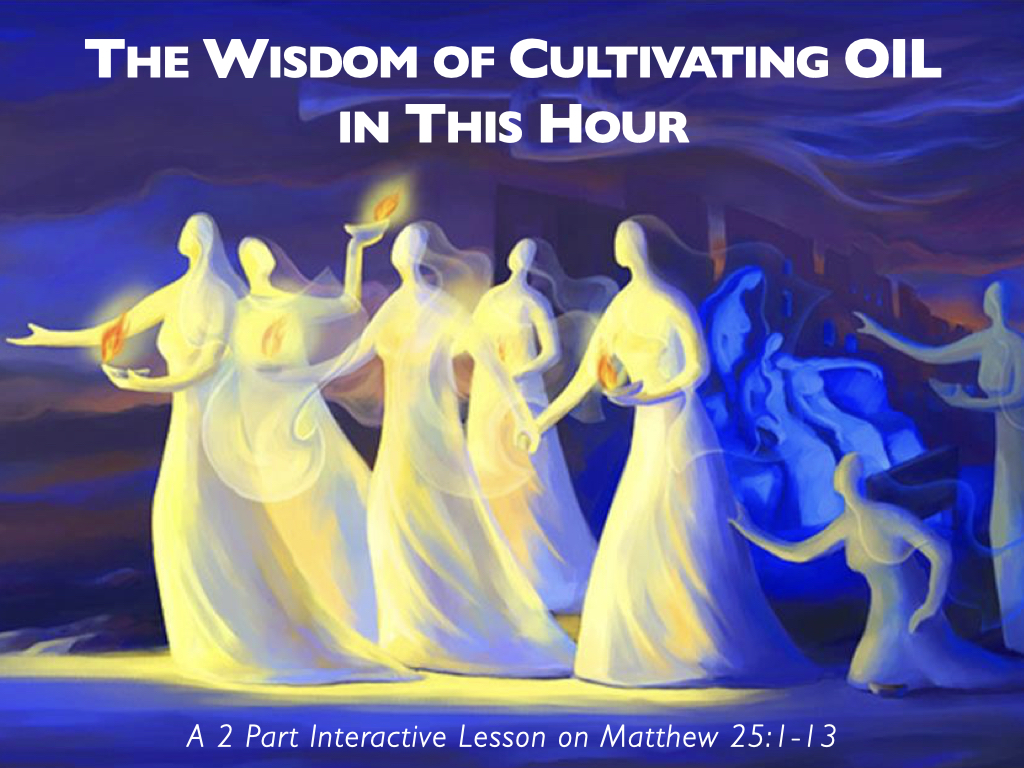
The Wisdom of Cultivating Oil in this Hour

An Interactive Two-Part Lesson on Matthew 25:1-13, Jesus’ Parable of the Wise and Foolish Bridesmaids

PREFACE:
All around the world, life, commerce, industry, worship patterns, families, districts and nations have been brought to a stand-still on account of our human susceptibility to a small germ. In a matter of weeks, the Lord has humbled 7.4 billion individuals in order to enter into conversation with them over the state of their soul.

How are we to understand this unparalleled human event? What is God wanting? What needs to change in our lives in order for us to make room for what He wants? What are we to prioritize? What are we to be concerned about in our lives? How do we respond to a God Who exhibits such universal control over humanity?

These may have been many of the same questions that the disciples were asking themselves as Jesus was telling them about the utter destruction and chaos that was coming to their nation, and the world in Matthew 24. These were to be the features of the end of the age? Their heads had to be swirling with questions.

In Matthew 25 Jesus begins to address these questions in the form of three parables – all three about the return of the Lord, and the transitioning of one age to another under the reign of the Messiah.
Whether we’ve given the return of Jesus much thought, or little thought, belief in His literal return is a foundational teaching to every stripe of Christianity. Every generation, on every continent, within every denomination of the Church declares that Jesus of Nazareth, an executed Jewish, God/Man is returning to earth in resurrected flesh to judge and rule the nations of the earth. This event will be even more profoundly paradigm-shifting than the events of Azusa Street, World War 1, World War II, the formation of Israel and the proliferation of the universal disease of unrighteousness, all combined. The impact of the events that will precede His second-coming will have on our world is inestimable. And yet, Jesus cuts through the sensational, in order to address the personal ramifications of His return. How is humanity to prepare for His return? How is the Church to prepare herself, and help humanity prepare for the new normal, the new values, and the new government that will surround His arrival?

These are some of the momentous questions that confront us as we take up a study of the first parable of the bridesmaids in Matthew 25. That we must address these difficult, hard-to-face questions is demanded by the terrible consequences of not dealing with them, attached to all three of Jesus’ parables in this chapter.

I. THE WISDOM OF UNDERSTANDING MATTHEW 25
A.
It is supremely wise for the Body of Christ to give themselves to understanding Matthew 24 and 25. Matthew 25 is the second part of Jesus’ answer to His disciples’ question about the “end of the age” (Matthew 24:3)

B. In Matthew 24 Jesus tells His disciples about the difficulties and deceptions that will accompany the end of the age. In the moments before He returns the Lord will release supernatural signs and calamities that will stir up great social, political and economic crises on the earth. These crises will deeply shake the emotions, beliefs and worldview of billions of people.

What great calamities may come to your world? How might this shake and threaten your life, your emotions, and what you believe about God?
_________________________________________________________________________________

C. At the beginning of Matthew 25, Jesus turns His attention to describing what His followers will need to do to prepare themselves for these unprecedented events. He does this by telling three parables. By using parables Jesus is able to instill a sense of alarm, impart truth, and invite His hearers into the mystery of the storyline. As we hear these parables, we’re invited into these same dynamics.

D. Jesus makes these parables intentionally alarming, because He loves us and doesn’t want us to be caught off-guard and unprepared. A good Father informs His children about life-threatening realities so that they can be appropriately equipped to face them, knowing that the crises can be overcome.

E. It is vital that we invest time to dialogue with the Lord now about Matthew 24 and 25.
1.  We want to have clarity on the Biblical narrative of the end times so we can, more or less, understand what issues are at risk.
2.  We want to have clarity on what kind of preparation we need to make for this hour in history.

F. A little clarity will produce great stability and confidence in our soul while our world is being buffeted by these extreme events. You don’t want to have to learn a new way of life in the midst of the demands and chaos of crises. Putting a little effort into understanding this hour of history now is like making sure you have enough water, food, medical supplies etc. in your basement for the storm that’s on its way. Beloved, intense storms are on their way. We don’t want to face them unaware of what the Bible has to say about them.

G. As we study this portion of scripture, the question the Holy Spirit is most eager to confront us with is: Through all of the pressures and trials that are here, and are coming, are you developing a lifestyle that’s cultivating oil?

How would you answer this question about your own life, right now?
_________________________________________________________________________________

II. A PARABLE ABOUT THE CHURCH
A. It’s important to know that this parable is a lesson about the Church, for the Church. This isn’t a parable about the non-Christians and the Christians. It’s a parable designed to stir the Church to consider those who have prepared for Jesus’ arrival, and those who have not. When we realize that Jesus isn’t speaking to someone else, or about something else, but that He’s talking to us, and about what we need, it makes His story all the more of a matter of concern.

B. How do we know this parable is about the Church, and not about the lost and the redeemed?
1.   All ten bridesmaids are waiting eagerly for the Bridegroom, and exhibit passion to go in and be with Him.
2.   All want to be in good-standing with the Bridegroom.
3.   All identify the Bridegroom as “Lord” (v.11).
4.   All have had oil; that which was necessary to go in with the Bridegroom.

C. What’s the lesson that Jesus is speaking to the Church?
1.   In chapter 24 He cautions them that because of the deception, difficulties and destruction of that hour the love of many will grow cold (Matthew 24:12). In Matthew 25, Jesus is alerts His disciples to not let their lamps go out, like the foolish bridesmaids.
2.   The distinction that Jesus makes between the wise and foolish bridesmaids is similar to the distinction Paul makes in Ephesians 5 when he advises the church: See then that you walk circumspectly; not as fools, but as wise – redeeming the time, because the days are evil. (Ephesians 5:15)Here, Paul is exhorting believers to pay attention to the vibrancy of their souls. He’s warning them to not give themselves to issues, activities, lifestyles and attitudes that will cause God’s life in them to dissipate (v. 18), diminish and waste away. Paul described the foolish as those who have departed from the faith giving heed to deceiving spirits… (1 Timothy 4:1) and have suffered the shipwreck of faith (1 Timothy 1:19) These are the same threats that Jesus exhorts His disciples to watch out for in Matthew 24.

D. The point of Jesus’ lesson isn’t to argue about how much faith is necessary to be saved. That’s a minimalist religious argument. Jesus wants His disciples to understand the tumult of the hour so that their relationship with Him is not hindered. He loves them and wants them make every provision so that when He returns they are ready to go in with Him (v.10) and are not unexpectedly turned away at the door.

How would you respond to Jesus if He were to pointedly confront you face to face with this parable?
_________________________________________________________________________________

E. The warnings of Jesus and the New Testament writers are clear. Mounting deception and the difficulties in our world will cause the faith and love of Christians to wane, and grow cold. We need to know this, and prepare our souls to withstand these intense circumstances.

III. THE GREAT VALUE OF OIL
A. It’s vital that we cultivate an appreciation for the great value of oil – especially the closer we come to the day of His return. We not only need oil, we need to know that we have oil.

What tells you (personally, today) that you do, or do not possess sufficient oil?
_________________________________________________________________________________

B. We need oil because, according to Jesus, the consequences of not having oil are so dire. Half of the bridesmaids do not have oil and not allowed to enter into the wedding feast. The foolish bridesmaids “alarm” at the midnight hour tell us how urgently we should pursue cultivating oil today. We do not want to hear the Lord say: “I do not know you.” (Matthew 25:12)

C. The Holy Spirit is passionately committed to preparing the Bride for the day of the Bridegroom’s arrival. The Holy Spirit is zealous that we, the Church, would make ourselves ready (Revelation 19:7)and be without spot, wrinkle or blemish when Jesus returns to rule over the earth. (See Ephesians 5:25-27) The Holy Spirit wants the Bride to be in joyful obedience to the Bridegroom when He arrives.
 1.   The truth is, in as much as the wedding banquet will herald a new Kingdom on the earth, the       wedding banquet will also function very much like an inaugural ball. As the event coordinator, the       Holy Spirit is zealous for us, the Church, ie. the “guests” to lavishly celebrate the new ruler, and be wholehearted in our zeal for His governmental reign.
2.   There are many ways that guests may attend an inaugural ball. Guests may attend reluctantly.       They may also participate out of a dull sense of obligation or duty. Guests may come with negative or contrary attitudes about the other guests, the election process, or the new ruler him/herself.
(Our attitude toward the Day of the Lord is actually a deep matter of discussion with the Lord. He has a lot to say about what might be in our hearts, [ie. bitterness, fear, shame, hostility, unforgiveness etc.] on the day He returns. He also has a lot to say about what He’d like to see in our hearts on that day.)
a.) When the bridegroom returns we will want to fully love (and rejoice at)His appearing (2 Timothy 4:8); not harboring “negative” thoughts about His arrival.
b.) We will also want to go in (in whole-hearted alignment and agreement) with Him (Matthew 25:10); not being offended by His character, His values or His behavior (as many were at His first-coming.)
c.) In the days ahead, there will be many things that will pose difficulties for the well being of our heart and soul. These difficulties will come in the form of many judgments upon the earth; judgments where millions will die. Millions will be more than inconvenienced. Billions will struggle for life-sustaining resources; be tempted to look to governmental solutions; be tempted to go to war with others over injustices; be tempted to even curse God and die.
3.   If we don’t have oil, we will be greatly tempted to be offended by others who will pose an       increasing threat to our life and our family’s lives. We will also be severely tempted to be offended by God and His judgements upon the earth.
4.   Oil is the lubricant that guards our hearts against the friction of offense. It enables us to joyfully herald His arrival and be in agreement with how He speaks and acts (about rewards and judgments, policies and management style) when He arrives.

Blessed is anyone who is not offended because of Me. (Luke 7:23)

D. Consequently, anything that keeps us from cultivating an abundance of oil in this hour is a dangerous distraction. We may give ourselves to many other kinds of activities, but if we’re being kept from cultivating oil we’re missing the point of this hour of preparation, and, most importantly, we’re allowing our soul to remain in a dangerous, compromised state.

The foolish virgins were without oil not because they were resisting the Lord’s return. They were quite enthusiastic for the Bridegroom’s return. The foolish bridesmaids were without oil because somewhere, sometime their “self-satisfaction” convinced them that doing something else was as important as their need to buy more oil.

IV. IDENTIFYING THE OIL
A. There are two prominent wrong interpretations of what the oil is.

B. Because these wrong interpretations produce a relaxed, lukewarm, laissez-faire attitude toward the lesson of Jesus’ story it’s important that we understand what these wrong interpretations are. We do not want to console ourselves about our readiness for Jesus’ return when the Holy Spirit is giving us no such consolation.

C. The two misleading interpretations are
1. The oil is the “Holy Spirit”. Though the oil comes from interaction with the Holy Spirit, oil is not itself, a synonym for possessing the “Holy Spirit”.
a. Where does scripture suggest we can accumulate a surplus of the Holy Spirit?
b. How does an individual go and buy more of the Holy Spirit?
c. How does one not immediately receive the Holy Spirit, when one asks for the Holy Spirit?
2. The oil is “faith”. Though it will ultimately manifest as faith, the oil is not a word-picture for faith.
a. A person, like the thief at the cross, may immediately have faith.
b. All ten bridesmaids had enough faith to know Who the Bridegroom was, to wait for his arrival, and wanted to go into the wedding feast with Him.
c. The five foolish bridesmaids exhibit faith when they identify the bridegroom as “Lord”.

D. Our description of the oil must be consistent with how Jesus describes the oil:
1.  It’s precious, and greatly desired.
2.  It’s costly to obtain.
3.  It can be accumulated in abundance.
4.  It cannot be transferred from one person to another.
5.  Without it we are kept from the presence and the reward of the Lord.

E. The Bible is filled with scriptural parallels to what Jesus is describing as “oil” in Matthew 25:1-13. What the oil represents is one of the most prominent themes in all of scripture.

Below are eight scriptures that give us clues about the precious nature of the oil. Each of these stories and texts are worthy of probing study and dialogue with the Holy Spirit.

1. The Matthew 25 oil is the one thing, the seeking, dwelling, beholding, inquiring, the seeking of the Lord’sFace and the waiting on the Lord of Psalm 27:4, 8, 14
What was David yearning for in Psalm 27?

_________________________________________________________________________________

2. The Matthew 25 oil is the abiding in Me, and I in you, of John 15:4 & 9
What does Jesus mean when He calls His disciples to abide?  What type of relationship is Jesus exhorting His disciples to in John 15?

_________________________________________________________________________________

3. The Matthew 25 oil is what Paul prays for the Ephesians church in Ephesians 1:17-18; that the God of our Lord Jesus Christ, the Father of glory, may give to you the spirit of wisdom and revelation in the knowledge of Him, that the eyes of your understanding being enlightened, that you may know what is the hope of His calling, what are the riches of the glory of His inheritance in the saints…
What dynamic(s) is Paul interceding for on behalf of the Ephesian believers?

_________________________________________________________________________________

4. The Matthew 25 oil is what we see Mary obtaining in Luke 10:39, when Mary sat at Jesus’ feet and heard His Word. Indeed, Jesus Himself says, Mary chose the one thing that was needed, the good thing that cannot be taken away from her.
What is it that Mary is hoping to receive from Jesus in this story?

_________________________________________________________________________________

5. The Matthew 25 oil is what we see Moses and Joshua receiving in Exodus 33:11;  So the Lord spoke to Moses face to face, as a man speaks to His friend. Moses would return to the camp, but his servant, Joshua, the son of Nun, a young man, did not depart from the tabernacle day or night.
What was Moses experiencing in Exodus 33? What is it that so captivated Joshua, that he would not leave the tabernacle day or night?_________________________________________________________________________________


6. The Matthew 25 oil is what the disciples were saturating themselves with in the upper room in Acts 1 & 2 as they continued with one accord in prayer and supplication prior to being baptized in the Holy Spirit.
What were the disciples experiencing in the upper room in Acts 1 and 2? What was the atmosphere like? What kind of exchange was going on?

_________________________________________________________________________________

7. The Matthew 25 oil is synonymous with the gold refined in the fire in Revelation 3:18 that Jesus counsels the Laodicean Church to buy from Him, that they may be rich.

What was Jesus exhorting the Laodicean church to secure from Him? How were they to obtain it?

_________________________________________________________________________________

8. The Matthew 25 oil is what Paul was ready to give everything up for in Philippians 3:10; that I may know Him and the power of His resurrection and the fellowship of His suffering, being conformed to His death.
What was it that Paul was yearning for?

_________________________________________________________________________________

Few studies will prove more fruitful in this hour than to dialogue with the Holy Spirit over these eight texts. He is vitally enthusiastic to disclose these mysteries to those who will seek His Face regarding the nature of oil.

Take time to review each of these 8 texts. Ask the Holy Spirit to show what each of these texts have in common. Then write out your own one-sentence definition of what the oil is.
_________________________________________________________________________________

V. DIALOGUING WITH THE HOLY SPIRIT ABOUT CULTIVATING OIL
A. At the end of the day, it’s vital that we seek God’s face for ourselves about the identity of the oil. Although a teaching can point the way, there’s no substitute for having the Holy Spirit impart His life- giving truths to your heart Himself.

B. As we increasingly see the value of oil, and our great need for oil we can rejoice knowing that we are in a blessed place. It’s the Lord’s supreme kindness to tell us “our oil is low”. (In this COVID-19 season, He’s even provided us with protected time and space to cultivate this oil!) If you’re feeling an increased desire for the abundance of oil in your life, rejoice! The Holy Spirit has planted that seed of awareness in your heart, and it’s taking root.

Blessed are the poor, (those who know that they lack) for their’s is the Kingdom of heaven. (Matthew 5:3)

C. In response to this growing hunger, it’s right for us to repent of having fallen asleep (Matthew 25:5) and not having pursued what the Holy Spirit has ardently wanted you, and the rest of the Bride of Christ to be filled with.

Our repentance is an act of humility that acknowledges His gracious and patient work on our hearts. It’s an act of contrition that says we’re sorry for having given ourselves to things which do not abundantly profit.
• It’s a pledge to no longer give our lives to dissipation.
• It’s a declaration of our will to obey Him, and embrace a new value.
• It’s a beacon to heaven signaling that our hearts are now ready to go and buy and receive.

Write out your own prayer of humility and repentance to the Holy Spirit here:
_________________________________________________________________________________

_________________________________________________________________________________

_________________________________________________________________________________

_________________________________________________________________________________

D. The foolish virgins were without oil not because they were resisting the Lord’s return. They were quite enthusiastic for the Bridegroom’s return. The foolish bridesmaids were without oil because somewhere, sometime their “self-satisfaction” convinced them that doing something else was as important as their need to buy more oil. The question for each one of us is: What did the enemy use to lure the foolish into a mind-set that distracted them from obtaining oil? How might you answer this question in your own life?

What issues, temptations, threats and world-situations might distract you from building a life that is prioritized to cultivating oil?
_________________________________________________________________________________

E. We can begin to engage the Holy Spirit through a straight-forward prayer like this:
We seek Your Face, Father. Holy Spirit, teach us about the oil. Show us the great value of the oil, and show us how to obtain it. We want to heed Jesus’ warning and be ready for His return. Forgive us for not pursuing either the oil, nor an understanding of the oil. Forgive us for spurning Your invitations. Give us grace to embrace a new value, and new priorities. Show us how to establish them in our lives, so that we live in a way that will produce an abundance of oil. Thank You for Your mercy, Your patience and Your willingness to give oil to us today. In Jesus’ Name.

End of (Part I)

The Way to Cultivate OIL in This Hour
Part 2 of 2

PREFACE
The value that Jesus attaches to the oil in this parable bids us to ask the question: How do I secure the oil I’m going to need to have in the moment of His arrival? This question should be addressed no less seriously than the question of whether we’re able to feed our family, provide for their safety and draw our next breath. The following section is designed to help the sober soul calculate their need and devise a plan to cultivate oil. As the old adage goes: to fail to plan is the plan to fail.

I. 4 QUESTIONS TO FOCUS OUR PURSUIT OF OIL
As we consider our own need for oil, there are several very beneficial questions we can keep in front of ourselves to help us set goals, confront obstacles and inspire us to accumulate oil. The parable tells us accumulation oil will require clear vision, cost-counting planning, a steady lifestyle that triumphs over inevitable slumber, and soul-satisfying inspiration and reward.

A. We need a clear vision.
One question we can ask to help us identify the clear vision of what we are pursuing is: What do I want my heart to be filled with on the day I meet our Bridegroom King?
1. The Holy Spirit is eager to meet us in this question and help us fill our hearts with the attitudes and qualities that are most pleasing to our King. This is a great part of what Revelation means when it observes: “Let us be glad and rejoice and give Him glory, for the marriage of the Lamb has come, and His wife has made herself ready.” (Revelation 19:7)
2. Some of the attitudes and qualities that I want my heart to be filled with in include: Awe, excitement, humility, gratitude, zeal for others’ well-being in God, compassion, tenderness, worship, yieldedness to His ways, agreement with His leadership, first-commandment love, trust, intimacy, no shame, purity, integrity, forgiveness, mercy-giving, desire for unity with Him and others, adoration etc.
3. On that day when we meet, one of the heart dynamics that will be most valuable to us will be to look into His smiling eyes and rejoice over the shared history of love that we had cultivated with each other. Episodes like this corona-virus season, are a marvelous, focused opportunity to increase in our focused love and understanding of this Man; a Man that we will soon see face to face.
4. Another way to ask this second question is to ponder the question: What is this Man worthy of? On the day that we first meet Him, as His eyes flash with zeal for righteousness and determination, our hearts will suddenly have new, first-person revelation about how much this Man is worthy of. Scripture keenly defines these qualities about Him so that we do not have to be surprised about Who He is then, but can be filled with understanding about Him now. The Holy Spirit is eager to give our seeking hearts revelation about the beauty and majesty of Jesus, so that we are prepared to give Him what we’ll want to give Him in that hour. In the moments that we first see Him, we will not want to be filled with regret about the little that we’re offering Him.

What do you want your heart to be filled with when you first meet the Bridegroom?

_________________________________________________________________________________

B. We also need to know what it will cost us to secure oil.
If we’re intent on cultivating enough oil sufficient for the day, we will need to ask the question: What will it cost me to purchase an abundance of oil?

1. Jesus tells us, the oil must be “bought” (v.9). The purchasing of the oil entails an investment of our wealth in that which is profitable (Isaiah 55:2) to have in our heart for that day… Again, engaging in this “divine exchange” is costly. (Revelation 3:18) Understanding the costly nature of oil leads us to reconsider adjusting the way we budget our lifestyle/time/ resources so that we do indeed accumulate “more”, and don’t merely console ourselves by thinking that because we wanted more, we, in fact, actually received more. We don’t want the mirage of oil. We want the manifestation of oil in our vessels. 

2. The question of cost also confronts us to examine the way we’ve been spending (or not spending) the “wealth” of our Christian lives: our time, energy, priorities and resources.
For which of you, intending to build a tower, does not sit down first and count the cost, whether he has enough to finish it – lest, after he has laid the foundation, and is not able to finish, all who see it begin to mock him, saying, ‘This man began to build and was not able to finish.”  (Luke 14:27-29)

Where have we allowed Christian activity and superficialities to marginalize His invitation to focused, intimate fellowship? Where have we neglected to make this investment in knowing Him? These questions are critical doorways unto the crushing, deepening, humbling work of repentance, apart from which no one may receive oil. At the end of the day, There is none who understands; there is none who seeks after God. They have all turned aside; they have together become unprofitable. (Romans 3:11-12)

We’re all dependent upon the gracious, patient pursuit of the Holy Spirit. No one receives oil without a repentant attitude. The need for a broken spirit and a contrite heart in accumulating oil cannot be overstated.

What will it cost you to purchase an abundance of oil? 

_________________________________________________________________________________

C. In the best of times, we can easily be diverted from cultivating oil. Therefore, it is wise to consider now: Are we developing the kind of lifestyle that will be capable to cultivate oil through all the testing, shaking, and judgments that are coming? We want to know: Do we have the depth and strength of intimate relationship with the King that will not be swayed with the increasing tribulation in our world? We want to know that we possess the kind of love that Solomon described in his Song of Songs:
Many waters cannot quench love, nor can the floods drown it. If a man would give for love all the wealth of his house, it would be utterly despised. (Song of Songs 8:7)

Am I developing the depth of love for the Bridegroom that can withstand the anxieties, accusations, deceptions and temptations that will increasingly fill our world?

What does a lifestyle that’s cultivating sufficient oil for an hour of tribulation look like?

_________________________________________________________________________________

D. When the way is foggy. When our hearts inevitably grow weary, we need a question to plumb-line our resolve. At the nexus of the whole endeavor is the question: Who is this Man? Who is this One Who is telling us about the end of the age, and warning us of the dire consequences of not preparing for its arrival? No other question begs to be explored more than the question about this Man’s identity and character. No other question will  provide more intrigue, fascination, passion, motivation or reward than allowing the Holy Spirit to draw you into the revelation of the uncreated, crucified and resurrected, Jewish, God/Man. This was the magnificent obsession of Mary in (Luke 10:39) and John the beloved in (1 John 1:1-3; Revelation 1:17).

The adventure of pursuing this question is all more compelling when we realize that it is Jesus Himself Who is drawing us to come close to behold His Person.
Father, I desire that they also whom You gave Me may be with Me where I am, that they may behold My glory which You have given Me. (John 17:24)

The revelation, and the experience of pursuing the revelation of Who He is, is pure oil.

This is also the question we will want to return to when the whole world is shaking, and we can’t see or think straight.

How would you describe Jesus of Nazareth? Who do you say that He is?
_________________________________________________________________________________


II. WATCH & PRAY: THE KEY TO CULTIVATING OIL
A. Watching and praying is Key to Obtaining an Abundance of Oil
Watch therefore, and pray always that you may be counted worthy to escape all these things that will come to pass and to stand before the Son of Man.
(Luke 21:36)
1. An abundance of watchful prayer produces an abundance of oil. Little prayer produces little oil. No prayer produces no oil. If we’re serious about cultivating oil, it’s absolutely essential that we take inventory on how much attention we’re giving to the focused activity of prayer.
2. Just as the five foolish virgins were deluded about their preparation for the Bridegroom’s return, many Christians live in tragic deception about the quality of their relationship with the Lord. The revivalist, Leonard Ravenhill declared: “No believer is greater than her/his prayer life.” No matter what else we may think we are, or have accomplished for the Kingdom, we are no greater than our intimate life of humility and dialogue before the Lord.
3. Jesus gives us a startling sneak-preview of His judgment upon the lives of mankind at the end of His sermon on the Mount. He warned that many would be sadly mistaken about the nature of the familiarity of relationship with the Lord when He asserts:
Not everyone who says to Me, ‘Lord, Lord,” shall enter the Kingdom of heaven, but he who does the will of My Father in heaven. May will say to Me in that day, ‘Lord, Lord, have we not prophesied in Your name, cast out demons in Your name, and done many wonders in Your name?’ And then I will declare to them, I never knew you; depart from Me, you who practice lawlessness.” (Matthew 7:21-23)
The parallel between Jesus’ words here I never knew you, and the parable of the ten bridesmaids (Matthew 25:12) I do not know you, should strike a two-fold witness to our heart.
4. At the end of his life, Billy Graham was asked if he had the chance to live his life over, what would he do differently? Dr. Graham’s response was quick: “I’d spend more time in prayer. I’d spend more time reading His Word and telling the Lord that I love Him.”
The dynamic, intimate relationship that is cultivated in honest, humble prayer is the essence of oil.

B. How then do we PRAY?
If we want oil, we need to know how to pray. If we want to know that we have oil, we’ll need to know that we have P.R.A.Y.E.D. The following acronym can help us identify a thorough way to engage the Lord in prayer – and He with us. These six qualities are not so much of a linear recipe to follow as they are a steady diet to fill ourselves with. Oil will be the reward of our engaging in these dynamics, just as physical health is the reward of a proper diet.

1. PROTECT and PREPARE
The fact of nature is, we cannot buy oil on the run. While it is possible to accumulate oil anywhere, it is impossible to secure it and not be given to much prayer.
a.) Moses and Joshua cultivated oil constrained to times and a “tent of meeting” in the wilderness.  (Exodus 33:7-11)
b.) Just before He ascended, Jesus bound His disciples to the experience of prayer. (Acts 1: 4) He told them not to leave Jerusalem. They obeyed Him, and gave themselves to prayer and worship in an upper room. (Acts 1:14) When they were baptized in the Holy Spirit their lifestyle was all-the-more bound the a rhythm that prioritized prayer.  (Acts 2:42, 46 and 3:1)
c.) If we do not, protect our time and place of prayer, the business of the day, the distractions of the world and the enticements of the urgent will flood our holy space.
d.) As a leader who has been ardently pursuing prayer for more than three decades, it is imperative that we set hours and space for our prayer time – or we will not pray. Neither will we establish the priority of prayer in our lifestyles. The wise Bridesmaids didn’t accumulate oil based on merely having a rhetoric of prayer. They had the reality of a real prayer-life.

2. RECEIVE REVELATION of the LORD and READING the Word of God.
a.) As we respond to the Holy Spirit in prayer, He immediately confronts us with revelations of the Lord’s beauty, His graciousness, His majesty, His Holiness. These revelations may flow from worship, or a hunger to read the Word, or they may come from the Holy Spirit directly, Who loves to take the qualities of Jesus and declare them to our “stilled” hearts.
We are experiencing what Jesus told us about the Spirit in (John 16:13-15):
The Spirit of truth… will glorify Me, for He will take of what is Mine and declare it to you. All things that the Father has are Mine. Therefore I said that He will take of Mine and declare it to you.
b.) As we behold Jesus, we also behold the way He relates to the Father, to others and the way runs His Kingdom, and in beholding Him we learn our own pattern for humility, love, holiness, kindness and zeal.
c.) We are not only informed by these Words of the Spirit, we are shaped and conformed by them.

We all, with unveiled face, beholding as in a mirror the glory of the Lord, are being transformed into the same image from glory to glory… (2 Corinthians. 3:18)

3. ASCRIBE, ACKNOWLEDGE and ADORE the character of the Lord.
a.) As we engage the Holy Spirit’s declarations about Jesus, our minds and our hearts are brought into alignment with the truth of Who God is. This is the dynamic work of the Holy Spirit. He is our guide in this indescribably glorious atmosphere. We are entirely dependent upon the His counsel on how to speak and behave. He will lead us into all truth. (John 16:14) As we see what He shows us, we yearn to respond according to the order of the realm in which we’re dwelling. In His gracious way, the Holy Spirit gives us Words, lyrics, jubilations, thoughts, visions, sensations that we may exalt, praise and magnify the Father, and the Son.

Ascribe unto the Lord, O you mighty ones, Ascribe unto the Lord glory and strength. Ascribe unto the Lord the glory due to His name; worship the Lord in the beauty of holiness. (Psalm 29:1,2)
b.) We tread fearfully, with an ever increasing desire to more fully and worthily enter into the beauty of holiness that is all around us. It is here that we see how intensely God’s desire is to
be intimately close with us.
Who may ascend into the hill of the Lord? Or who may stand in His holy place? He who has clean hands and a pure heart… He shall receive blessing from the Lord, and righteousness from the God of his salvation. This is Jacob, the generation of those who seek Him, Who seek Your face. Selah Lift up your heads, O you gates! And be lifted up, you everlasting doors! And the King of glory shall come in. Who is this King of glory? The Lord strong and mighty, The Lord mighty in battle. Lift up your heads, O you gates! Lift up, you everlasting doors! And the King of glory shall come in. Who is this King of glory? The Lord of hosts, He is the King of glory. (Psalm 24:3-11)

4. YIELD
a.) In the atmosphere of holiness, we would be consumed by His mere breath if we were not to align our hearts, mind, will, words, attitudes, behaviors etc.; all that we are, with the truth of Who we are encountering. This is the process of repentance, humility and yieldedness. b.) In the worship of repentance we divest ourselves of that which pollutes this holy atmosphere. We surrender sin, selfishness, fleshly wisdom and all forms of unrighteousness, all with the expectation of entering more fully into the goodness of His increasing reign.
c.) Yieldedness and repentance is the response of all creation to the approaching presence of the uncreated God. This is what Isaiah was describing in (Isaiah 40:3-5)
Prepare the way of the Lord; Make straight in the desert a highway for our God. Every valley shall be exalted and every mountain and hill brought low; The crooked places shall be made straight and the rough places smooth; The glory of the Lord shall be revealed, and all flesh shall see it together; For the mouth of the Lord has spoken.
d.) In the revelation of the Lord’s ascending glory, it is only right that we have a “yes” and “amen” in our spirits. This is our proper response to the way of Jesus. We operate in fidelity and agreement with Who He is, What He’s promised and What we’ve asked of Him.
For all the promises of God in Him are Yes, and in Him Amen, to the glory of God through us. (2 Corinthians 1:20)
e.) But in heaven this yieldedness is a two-fold yes.Our yes to Him, also means that we tap into His miracle of agreement with other believers who are praying and cultivating oil. Though the oil may not be transferred, one to another here on earth – each has their own secret life with God – we have the capacity to encourage, inspire and amplify other members of the body of Christ as we cultivate oil together. This is the exponential power of corporate prayer and worship.
Behold, how good and how pleasant it is for brethren to dwell together in unity! It is like the precious oil upon the head… (Psalm 133:1-2)

5. ENTREAT the LORD
a.) It’s in this context that we come before the throne. It is a great throne, but it’s a throne of grace.
Let us therefore come boldly to the throne of grace, that we may obtain mercy and find grace… (Hebrews 4:16)
b.) The King Himself invites us and has even (wonder of wonders) made provision for us to sit with Him, in the seat of authority.
(He) raised us up together, and made us sit together in the heavenly places in Christ Jesus (Ephesians 2:6)
c.) Here we may ask and participate in the eternal order of the Kingdom: intercession. It’s as we watch Jesus ask the Father for His Hand on issues, circumstances, nations, creation, and individual hearts that we learn the Family way of the Kingdom – and we too, ask, entreat, petition and make requests of the Father.
“And whatever you ask in My Name, that I will do, that the Father may be glorified in the Son.”(John 14:13)

6. DIALOGUE
a.) In prayer with Him; surrounded with His glory, we are given (prompted by the Spirit’s initiative) to make inquiry – and to engage the Trinity in conversation. This is the what we were created for; first Adam, and now us: communion with the Word-speaking God.
b.) This dialogue with God is what Moses was invited into.
And it came to pass, when Moses entered the tabernacle, that the pillar of cloud descended and stood at the door of the tabernacle, and the Lord talked with Moses…So the Lord spoke to Moses face to face, as a man speaks to his friend. (Exodus 33:9,11)
c.) This intimacy is what David was describing in Psalm 27:4 and 8
One thing I have desired of the Lord, that will I seek: That I may dwell in the house of the Lord all the days of my life, to behold the beauty of the Lord, and to inquire in His temple..
…When You said, “Seek My face,”My heart said to You, “Your face, Lord, I will seek.”

d.) This is also the dynamic word-shaping power that we share with other believers, even while still on earth: Speaking the truth in love, one to another; in this way we grow up in all aspects into Him, Who is our Head. (Ephesians 4:15)

III. BURNING WITH THE PROPHETIC CRY
A. In this hour, the Spirit is crying out to the Church and the world.
“Wisdom shouts in the street. She raises her voice in the markets.” (Proverbs 1:20)

B. It is a cry that the Spirit is zealous to proclaim with the Bride; one that illuminates the Bridegroom, that heralds His coming and calls all into allegiance to the approaching the Bridegroom King.

C. The cry is meant to be a corporate cry of agreement that looks and feels like the unanimity in heaven and is in league with the power of the Spirit.
Behold the Bridegroom! He’s coming! Go out to meet Him! (Matthew 25:7)

D. This is the cry the world urgently needs to hear – with clarity! And it’s the cry that will usher in earth’s last revival; the salvation of billions of souls. It will also herald the greatest transition in the history of the world.

E. This cry may only be fueled by the oil we receive. In order for this cry to be clear and compelling, we must know Him (Matthew 25:12) intimately. We must cultivate the oil of intimate encounter with Him. The oil we receive burns unto one end: the illumination of the Bridegroom, Himself! As our lamps burn, they illuminate His beauty wherever we go.
1. The call to cultivate oil is the Holy Spirit’s “new normal” for the Church. All around the world, at the same time, the Holy Spirit is leading the whole Church into a brand-new Bridegroom-engaging, Bridegroom-dependent, Bridegroom-increasing normal.
2. There is no going back. It’s vital that we go forward, accumulate oil, take our lamps to illumi- nate the Bridegroom, and go out to meet Him. The Holy Spirit will have it no other way.
3. a.) The “new normal” isn’t about remote teaching, or house to house restructuring, or developing critical care networks. It’s all about securing oil.
b.) The one question that dominates the dialogue of heaven as our world throws off this season of “lock-down” is: “Did the Church learn how vital it is that she have oil?” 
c.) The church that doesn’t humble herself, shift her paradigm, prioritize, and practically give herself to cultivating oil will not remain in the hours that are approaching… It may know enthusiasm, new technology and renewed energy, but she will not know the abiding, dwelling, presence of the Lord. Her many words and activity will be kicking against the goads… not making the “rough places smooth” (Isaiah 40:4) for the revelation of the glory of the Lord.
4. Beloved, anything that keeps us from cultivating oil in this hour is a distraction – a dangerous, slumbering, self-content, destructive, distraction.

Write out your own pledge to the Lord. What specific details are you hearing Him call you to put in place in your daily life?
_________________________________________________________________________________

_________________________________________________________________________________

_________________________________________________________________________________

_________________________________________________________________________________

____________________
JSB • Spring, 2020

A PDF Version of this teaching can be downloaded here:
https://drive.google.com/file/d/1rWSv50DcNWJ0aC_UZqMWWA9ssDcY2GFf/view?usp=sharing

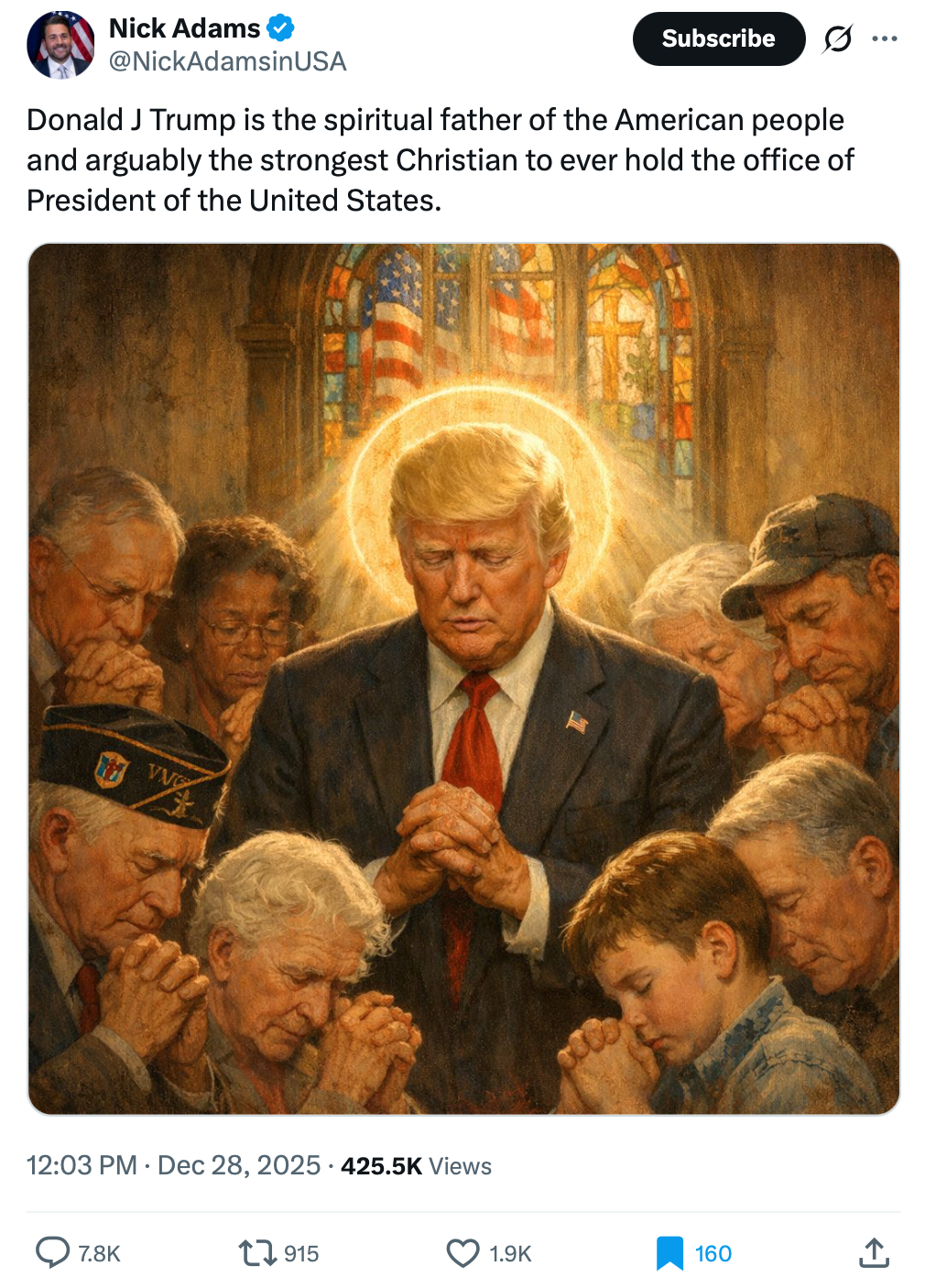
A Sober Warning, An Arresting Lesson, and An Ardent Prayer for the Church in America as We Enter 2026

As the days/weeks/months roll on, and MAGA continues to do headstands to sweep the mountain of evidence re: Donald J. Trump‘s long, sick record of sexual predation under the rug, it has become tragically obvious – there is nothing that can be found in this man that will restrain our family’s cultish devotion to him. A vast swath of American evangelicalism remains slavishly entrenched in the fog of a very great delusion, embracing, defending, and going to war for every word from, and about Trump, his enemies, our nation, and the world. The facts, contradictions, and contra-Kingdom quotes from Trump himself, no longer matter. Everything is measured in terms of whether the narratives paint our vaunted hero with positive glory, or a negative pall.

And so, near daily, our family busies herself explaining away ludicrous, hate-filled, and self-incriminating statements from a life-long adulterer, and con-man; reasoning ourselves into justifying hostile, aggressive, and prideful policies, orders, and executive decisions; building cases that give support to outlandish, baseless storylines; or turning a blind eye to mounds of evidence that display the godless corruption that warps this man’s soul.

And when our political rhetoric runs afoul of the Word of God, and countermands the image of Christ Jesus to Whom we have pledged allegiance, we’ve become adept at finding loopholes to the Sermon on the Mount, dismissing the criticism of other conservative evangelicals as “divisive”, “deranged”, or “duped by the vast, nefarious forces that are attempting to bring our dear leader down.” We spare no energy to keep this man’s golden image creditable. And in far too many instances, the imagery we prop up, and all of its attendant twisted plots and fantastical redactions, becomes our definition of what the righteous anointing of God looks like. (See the Nick Adams meme below…) We become the backstage enablers of Elmer Gantry.

It’s the greatest subversion of the ideals of Jesus’ Kingdom in our generation, and one of the most consequential in the history of the Church in America.

With supernatural breath, the Lord is intensifying His summons to our fellowships, conferences, prayer-gatherings, and Bible-studies: We can either humble ourselves and wholly walk with intimate fidelity to Jesus in this midnight hour, or we can discount the many calls to repentance, and continue to prostitute ourselves to this boastful man of lawlessness at the peril of being severely judged, and even risking rejection from our coming King.

The New Testament scriptures are filled with references to those who draw near to Jesus with their lips (Matthew 15:8), whose love becomes distracted, and grows cold (Matthew 24:12) and are ultimately leveled by the King of glory’s sobering true analysis of their lives.

Five of the seven churches in Revelation have arresting, “let Me set the record straight” encounters with the resurrected Jesus (Revelation 2:4; 2:14; 2:20; 3:1; 3:16-17).

In both Matthew 7:23, and Matthew 25:12, Jesus lays out two scenes at the end of the age when He will shock those who anticipate joining Him in eternity with these words: “Depart from Me. I do not know you.”

These will be the most horrible confrontations in the history of humanity.

“Depart from Me. I do not know you.” It’s extremely wise for us to slow down, and take in these Words of life from Jesus Himself. How does He mean for these lessons to equip us to live today, in 2026?

First, we notice that Jesus doesn’t make this pronouncement upon those who a.) don’t know Him, who b.) don’t seem to believe in Him, or c.) desire to be with Him. Jesus doesn’t say, “Depart from Me, you never knew the right things about Me.” He makes these determinations to those who have been doing the stuff in His Name (Matthew 7:23), and who genuinely want to be with the Bridegroom. (Matthew 25:12)

This should trouble us to prayer, and a boat-load of honest dialogue with the Spirit of internal Truth. Because in these two texts, Jesus is saying that there are at least “some significant number” of “Christian” folk who sincerely believe they are walking faithfully to Him; perhaps even some who (along with the devil and his angels [Philippians 2:10]) are asserting that #ChristIsKing – who are deluded in their thinking; and are, indeed, in great danger of being turned away from Christ, in the very moment that they expect to be gladly received by Christ.

In both of the stories, JESUS TURNS AWAY THOSE WHOM HE DOESN’T KNOW. This phrase may have one or two meanings. Both of them are terrible.

The first meaning of this statement could apply to those who, in spite of their rhetoric, their theological assertions, and/or their vaunted Christian ministries, actually end up thinking, acting, and looking nothing like Jesus. They don’t love unconditionally. They don’t forgive. They force their own way. They don’t value the fruit of the Spirit. They refuse to walk in the deep ways of lowliness. They haven’t begun to love the Father more than everything else in this world.

The second potential meaning is more intrinsic and personal. Jesus’ pronouncement could mean that the ones He’s rejecting never made themselves known and vulnerable to His holy and gracious gaze. They did not humble themselves to the point of broken repentance. They never heeded the Words of the prophets, and exposed their baseline selves to the light of His purifying love. They never learned to cultivate lives that were intimately pliable, and dependent upon the “new every morning” (Lamentations 3:23) mercies of the Lord.

In essence, Jesus is saying to the ones He’s rebuffing, “You withheld your self from Me. You did not bare your soul, your sin, your proclivity to sin and unrighteousness to Me. You never let Me in to recalibrate your carnal way of thinking and treating others. You kept returning an eye for an eye – living according to the hostile, anti-meek, unholy spirit of the world that you were born in. You gave yourself to conspiracies, bitterness, idolatries, and self-exonerating rhetoric, and never let Me change the root-loyalties of your heart.”

And to the point, when push comes to shove, and our President is found making violent statements about his adversaries, we defend the murder that’s in his heart, rather than our Lord’s value for forgiveness and meekness. When Trump threatens other nation-states, we justify his aggression, rather than champion the blessed fruit of peace-making. When he makes grotesque and wildly false pronouncements, rather than quietly speaking for temperance and truth, we legitimize his falsehoods with bizarre theories. And when his legacy of sexual predation surfaces through the testimonies of dozens of abused young women, or his own admission, rather than apply the level of adjudication we’d apply to any of his political enemies who might be suspected of one-tenth of what he has credibly been associated with, we sweep all accountability to the Spirit of God away with the blithe exoneration: “No one can know what’s really going on in another man’s soul”.

I’ll say it again. We are participating in the greatest perversion of Christianity in our lifetimes; a betrayal that is greatly discrediting our witness to the ways of the Kingdom; the character of our Savior’s heart, and one that discloses where our fundamental faith really lies.

When Jesus breaks into our reality, (Luke 18:8) tells us that He will be looking for bonafide faith in His earthly Bride; one that exalts the values of Spirit-empowered, 1 Corinthians 13 love as the means to redemptive, incarnational justice.

Am I saying that millions of our evangelical family members don’t believe in the true God? Am I saying that anyone who continues to defend Trump is doomed to hell? Am I saying that Trump is the antiChrist, or am I seeking to divide our Lord’s Bride? No. I’m urging all of us, including myself, and the many believers who are alarmed about our family’s unparalleled obeisance to this one President, to not forget that “the days are evil” (Ephesians 5:15), to “take every thought captive” (2 Corinthians 10:5), and to fastidiously remain true to our King, encouraging and exhorting our fellow sisters and brothers in Christ, with the knowledge that many in our ranks today will be eternally grief-stricken, when the Lord stands before us, separating the sheep from the goats.

My ardent prayer for myself, and our family as we step into this new year, (it’s what I do) is the one the apostle Paul prayed for the saints in ancient Turkey: “We do not cease to pray for you, and to ask that you may be filled with the knowledge of His will in all wisdom and spiritual understanding; that you may have a walk worthy of the Lord, fully pleasing Him, being fruitful in every good work and increasing in the knowledge of God; strengthened with all might, according to His glorious power, for all patience and long-suffering with joy; giving thanks to the Father Who has qualified us to be partakers of the inheritance of the saints in the light.” (Colossians 1:9-12)

The potential consequences of our faithlessness is great. But the rewards for our deep, and vibrant faithfulness is immeasurably greater.

____________________
JSB • December, 2026

The Broken Element in Christian Nationalism

Blessed is the one who does not judge himself by what he approves.” (Romans 14:22)

As the fervor of Christian Nationalism continues to expand within the American evangelical Church, it’s vital that sincere, covenant followers of Jesus Christ be able to distinguish between what is New Testament Christianity, and what is a perversion of the Way. This task of discernment requires at least four critical elements.
1. It requires that we accept the Word of God as the first, last and foremost resource for the formation of true spiritual understanding.
2. It requires that we be people who actively listen to, and dialogue with the Holy Spirit, Who illuminates, and “teaches us truth”, from the Word.
3. It also requires that we cultivate an ear to hear the Spirit’s circumspect truth re the external issues in the fallen world, as well as honest perspective re the true, attendant issues (pride, fear, lust, hostility etc.) in our own heart.
4. It requires that we have a primary predisposition to die, and submit our sin-disposed selves to an ongoing journey of applying the truths that the Holy Spirit shows us in the Word, in our world, and within our own selves.

It is primarily in the neglect of this fourth element that many in our Christian family are becoming ensnared in the allurement of American Christian Nationalism. We say that we are people who “rightly divide” the Word of God, and apply its true light with objectivity to our lives and our culture. And so we may rightly deduce that the Word of God stands firmly against matters of sexual infidelity, atheism, destruction of human life, and the honor of God. But do we also hear what the Word says about the innate predisposition of our own soul to self-gratification, self-glorification, self-evaluation, self-determination, and self-sufficiency? Who is helping us to ruthlessly, and responsibly apply the truths of the Word that expose the pride, the lust, the covetousness, and the hostility that vexes our own souls? Are we committed to such excruciating integrity of character, even at the expense of our own “image”?

Simply put, where zeal for truth exists alongside a spirit that has no will or intent of being leveled by that truth, truth profits us nothing. Indeed, where this spirit persists you will find all kinds of pretentious viciousness, depravity and wickedness.

Where the corrupting plots of Christian nationalism are concerned, I do not pray for individuals to find “true truth”; by either discovering how evil, or good an individual, or talking point is. I pray for our neighbors, sisters, and family members to be swallowed up in a spirit of humility and cross-bearing that surrenders to Jesus, as the Way of truth…

This is an ENORMOUSLY IMPORTANT distinction.

It isn’t the false narratives that chiefly corrupt Christian nationalists. The subversive force of Christian Nationalism is its stubborn repudiation of the baseline dynamic that connects human beings to a Savior, and a King – humility, gratitude for mercy, meekness, quietness, deep trust, repentance, chesed-love, and despair of self.

What Christian nationalism offers our greedy culture is an endless appetite for “truth storylines” that will “guarantee” greater security, stability, and self-worth. By contrast, what heaven offers this same homicidal, and unstable world, is a baby.

This personalization of truth is what Pilate stumbled over. (John 18:38) It was also what offended the Pharisees when Jesus answered their theological questions by pointing to Himself. “Before Abraham was, I Am” (John 8:58), and “unless you believe that I Am He, you will die in your sins” (John 8:24), and “I (Myself) Am the Way, the Truth, and the Life” (John 14:6), and “This is the work of God, that you believe in the One Whom He has sent.” (John 6:29).

Jesus’ scandalous personalization of truth is what offended many of His disciples to the point that they no longer followed Him. “Unless you eat My flesh and drink My blood…” (John 6:53) Essentially Jesus was saying, “I Am pure theology. And I AM all the theology you need. Unless you feed on Me, all your theology getting will not profit you one bit. Unless you lose your life-seeking ways, you are not worthy of anything else I’m going to say.”

This is why Jesus didn’t feed His disciples nefarious conspiracies about the workings of an evil world. He knew their uncrucified selves wanted to build utopias on earth with this “dirt information”. Jesus knew what was in the heart of humanity… They wanted a king; a king who would make sure they had an abundant supply of the fruit from the tree of the knowledge of good and evil… so that their unbowed souls could attain to the levers of power and influence that their prideful selves believed they deserved – and were even destined for. This innate, ubiquitous desire is common to all of mankind. It was what the Lord abhorred in Israel when they clamored for a king in (1 Samuel 8:7) “The Lord said to Samuel, ‘Do everything the people request of you. For it is not you that they have rejected, but it is Me that they have rejected as their king.'” 

(Aside: This is also the root of why the Christian nationalism that’s festering in our nation, directly parallels with the Christian nationalism that overtook the church in Germany less than a century ago. There was a reason the devil gave the Nazi’s a broken cross for its emblem. And through it, he achieved some of the greatest evil ever perpetrated in human history… something to meditate on…)

In place of our daily reach for “the truth”, the Lord, Who is Spirit gives us great grace to lay down our lives for the increase of His desire to intimately reign over all people. If you can receive it, this grace is an even more endemic and life-giving truth about ourselves, and His ability to intimately lead us; one that isn’t built on merely collecting greater insight and being able to identify the machinations of a curse-riddled world, but one which brings forth the breaths of life itself, through deeper, and more wholehearted unity with, and sacrificial love for the Lord of life, Himself.

____________________
JSB • December, 2025

Waiting and Hastening: The Bridal Paradox of Prayer

9 The LORD is not slow concerning HIS PROMISE, as some regard slowness, but is being PATIENT toward you, because He does not wish for any to PERISH but for all to come to REPENTANCE. 10 But the DAY OF THE LORD will come like a thief; when… the earth and EVERY DEED DONE on it will be LAID BARE… (therefore) WHAT SORT OF PEOPLE SHOULD YOU BE, CONDUCTING YOUR LIVES IN HOLINESS AND GODLINESS, 12 while WAITING FOR and HASTENING THE COMING OF THE DAY OF GOD? … According to His PROMISE, we are WAITING for new heavens and a new earth, in which RIGHTEOUSNESS truly resides. 14 Therefore, DEAR FRIENDS, since you are WAITING FOR these things, STRIVE to be found AT PEACE, WITHOUT SPOT OR BLEMISH, when you COME into HIS PRESENCE. (2 Peter 3:9-14)

The Lord’s preparation of the Church is one of the most overlooked, New Testament dynamics that is (day by day) impacting the people of God right now. Whether we see it or not, the truth is, the closer we get to the return of Jesus, the more the heart and the collective mind of the Bride is being refined to both understand and champion the reign of our King!

Jesus is not coming to “take us home”. If we’re in Christ, we’re already home! He’s coming to rule and reign on the earth, WITH HIS BRIDE IN GLAD-HEARTED CELEBRATION of the way He administrates His Kingdom. 

Right now, the Church is still “working the issues out” in our collective thinking. Our narratives are not filled with appreciation for the ways of our King. We don’t esteem the values of meekness, holiness, patience, and mercy-giving the way our King does. In fact, we count much of what He wants to work into our world as foolish, unpractical, and/or too religious. Where Jesus calls us to “serve”, we want to dominate. Where Jesus calls us to “pray”, we want to rush to action with human power. Where Jesus wants to aim at relationship, we want to build laws and structures. This disconnection from Jesus’ mind is what both Peter (here in 2 Peter 3:14), and Paul (in Ephesians 5:26,27) call “spots, wrinkles, and blemishes”. This is where the Bride is operating unlike Christ – where we are not Christlike!

So, how does the Lord bring us into like-mindedness? How does He conform us to His image?How does He cultivate both an understanding and appreciation of the ways of His leadership?

He shapes us by employing two living and active realities. The first are the affairs of 200ish nations, and the pressure points in our own lives. These are actually “grinding bearings” that the Lord uses to drive us to Himself. Where the answers are “out of our reach”, and “beyond our under-standing”, He nonetheless calls us to bring the tension points to Him, in both humility, and honesty. This means that we don’t allow other players to become the primary “shapers” of our narrative. It means that we bring what we see, what we know, and what we feel, into the “tent of meeting” with Him, and allow Him to illuminate our minds, and our hearts about both the facts of the storylines, and the issues they create in our own lives. He may or may not want to tell us the details about the nefarious activities of globalists. But He will most certainly want to talk to us about how these true or false reports are shaping our trust in Him, and our love toward others. Make sense?

The second living and active reality that He’s using to shape the Bride is His own Word. 

Paul writes: “He (Jesus) sanctifies her, and cleanses her by THE WASHING OF WATER WITH THE WORD, that He might present to Himself the Church in all her glory, having no spot or wrinkle or any such thing; but that she would be holy and blameless.” (Ephesians 5:26-27)

Jesus uses both the crises in our world, and our daily, disciplined commitment to engage Him in prayerful dialogue with His Word, and in this kinetic mixture, He shows us how He leads, how He redeems, how He analyzes, how He rewards, and how He purges humanity, and the human spirit. And then He calls you and I, His Bride, to agree in prayer with Him about the ways and the intents of His government.

It’s in this turbulent forge that our Bridegroom King forms and purifies our thoughts, responses, attitudes, countenance, and will. As we bring our outrage, passivity, temptations, and promises in the context of these worldly, national and personal crises into His courts, with truthfulness, a spirit of yieldedness, a dash of expectation, and a will that is prepared to give Him the gift of repentance, He is faithful to remove the impediments (the spots, wrinkles, and blemishes) so that His authority can freely work in, and through our lives. This is how we, the Bride, are conformed to His Image. This is what it means to be aligned to the “true righteousness” (v.13) that He will manifest on the earth when the fulness of His Kingdom comes. We do this by faith, now, in anticipation of it fully coming when He comes. And this is, according to 2 Peter 3:12, (wonder of wonders) how we “hasten the coming” of that Day – His Day – when He rules in our physical presence!

Until that Day comes, 2 Peter 3 tells us to “wait” three times! This is an exhortation to
a.) abide in, and not lose touch with this truth,
b.) to walk in growing patience and peaceable confidence in the Lord, and what He is accomplishing, and to
c.) give ourselves to these conforming dynamics with abandon. 

However, the Kingdom of God is always a paradox. In the context of patiently “waiting”, v.14 also charges us to “strive”. (This paradox keeps us from turning the dynamics of the Lord into a math equation – and keeps us close, and reliant upon the nimble, intimate, breath-by-breath leadership of the Spirit.) It is by the Spirit that we “strive” toward coming to the place of “peace” with the Lord’s Bridal purification process. We are in His more than sufficient Hands. We belong to Him. We are in His care. He knows how to get ahold of us. He has our number. He knows how to call us out. He isn’t perplexed about how to bring you, your family, your Bible-study group, your community, and your nation into agreement with His ways. v.14 is the Spirit’s loud encouragement to “TRUST THE KING’S PROCESS!” He will bring us forth, into His Presence, without “spot” or “blemish”; purified; like a sacrificial lamb; ready to be offered up to Him; wholly yielded to His majestic reign.

This is His goal: that we come forth, by His power, united to Him, and each other, loving Him and His ways with all our heart, soul, mind and strength. (Mark 12:30)

This has massive implications for HOW WE “DO CHURCH”. It underscores the vital necessity that we become a people of daily, reliant PRAYER. WITHOUT BEING MUCH IN PRAYER THE BRIDE WILL NEITHER BEHOLD NOR YIELD OUR HEART AND OUR WAYS TO THE LORD’S REFINING WORK. NOR WILL WE LEARN TO WALK IN THE AUTHORITY OF HIS DIVINE ORDER.

This brings us to the other side of the coin. And it is the reason that spurs the apostle Peter to write these injunctions in the first place. Should we neglect, and/or withdraw from Jesus’ capable, prayerful, purifying process; should we instead, give ourselves to spiraling conspiracies, spouting our own opinions, -becoming rigid in our carnal thoughts, we will not come forth in mature love. We will actually come forth with a mutant love – shaped by our world, the devil, and our own corrupt soul. Perhaps, (or perhaps not) filled with “Christian-sounding” rhetoric – but no substance, and no fruit.

When we neglect Jesus’ prayerful, purifying process, and instead, give ourselves to spiraling conspiracies, opinions, and rigid carnal thoughts, we will not come forth in mature love. we will come forth with a mutant love.

The wretched truth of the matter is, when we refuse to give ourselves to His ongoing refining process, we are in essence saying to Jesus: “WE REALLY DON’T LOVE YOUR RULE AND REIGN in our world. We would rather continue to have our own way, under our own power, than have You remove the SPOTS and BLEMISHES from our hearts… We’d rather You NOT do what You want to do to manifest Your vibrant RIGHTEOUSNESS through our lives.”

This is the spirit of antipathy. This is the spirit Peter calls us to “strive” against. This posture will produce endless enmity (and never “PEACE”) in our lives. And, truth-be-told, it is the sentiment, and slant that accounts for SO MUCH of the hostility in the Church today.

Beloved, the Lord is not relenting. He will not let us sleep-walk through the fires that He has kindled in our world. He is a holy-disturber of our “false peace” Who is making every provision for us to be aligned to Himself, in joyful unanimity with His Kingdom.

Let’s go into the place of prayer, and wholly give ourselves to His refining process. Let’s hasten the return of our King!

____________________
JSB • December 12, 2025

The Forsaken Truth About the Wrath of God

99 Biblical Texts on the Wrath of God

PREFACE
The wrath of God is one of the top ten most neglected topics in the Body of Christ in our generation. There are more than 150 distinct references to the wrath of God in the scriptures. The three books of Jeremiah, Ezekiel and Revelation contain about a third of the references to God’s wrath, but the wrath of the Lord is found in the Pentateuch, Israel’s history, Psalms, Proverbs, the major and the minor prophets, the gospels, the epistles and the book of Revelation.

A robust understanding of the wrath of God will enrich our appreciation for the judgments of the Lord, the fear of the Lord, AND the tremendous mercy of the Lord.

The wrath of God is different than the judgments of the Lord. The judgments of the Lord are about reward, encouragement, correction, discipline, rebuke and punishment. The wrath of God is punishment. Often severe punishment. And many times final punishment.

None-the-less, the 21c American Church largely lives as though the wrath of God does not apply to us. This is an enormously dangerous way to live.

We have been experiencing a long season of the judgments of the Lord. (A longer season than most revivals last…) One of the reasons the Lord leads us through long seasons of patient judgment, is to forestay His Hand of wrath.

Unfortunately, our response to the judgments of the Lord has not been repentance, and surrendering ourselves to His glory. Our response to the judgments of the Lord has been to wave the bill of rights in His Face, and the faces of our enemies.

This is precisely the Biblical pattern of human behavior that invites the wrath of God upon a people.

Father! Sober us to the reality of Your judgments and Your righteous wrath! Raise up prophetic voices that will bring the Church to our knees!

Below are 99 scriptures on the wrath of God…

Leviticus 26:28
Then I will act with wrathful hostility against you, and I for My part will punish you seven times for your sins.

Numbers 1:53
But the Levites shall camp around the tabernacle of the testimony, so that there will be no divine wrath against the congregation of the sons of Israel. So the Levites shall be responsible for service to the tabernacle of the testimony.

Numbers 16:46
And Moses said to Aaron, “Take your censer and put fire in it from the altar, and place incense on it; then bring it quickly to the congregation and make atonement for them, for wrath has gone out from the Lord, the plague has begun!”

Numbers 18:5
So you shall perform the duties of the sanctuary and the duties of the altar, so that there will no longer be wrath on the sons of Israel.

Numbers 25:11
Phinehas the son of Eleazar, the son of Aaron the priest, has averted My wrath from the sons of Israel in that he was jealous with My jealousy among them, so that I did not destroy the sons of Israel in My jealousy.

Deuteronomy 29:20
The Lord will not be willing to forgive him, but rather the anger of the Lord and His wrath will burn against that person, and every curse that is written in this book will lie upon him, and the Lord will wipe out his name from under heaven.

Joshua 22:20
Did Achan the son of Zerah not act unfaithfully in the things designated for destruction, and wrath fall on the entire congregation of Israel? So that man did not perish alone in his guilt.

2 Chronicles 34:21
Go, inquire of the Lord for me and for those who are left in Israel and Judah, concerning the words of the book which has been found; for the wrath of the Lord which has poured out on us is great, because our fathers have not kept the word of the Lord, to act in accordance with everything that is written in this book.

2 Kings 22:13
Go, inquire of the Lord for me and for the people and all Judah concerning the words of this book that has been found, for the wrath of the Lord that burns against us is great, because our fathers did not listen to the words of this book, to act in accordance with everything that is written regarding us.

2 Kings 22:17
Since they have abandoned Me and have burned incense to other gods so that they may provoke Me to anger with all the work of their hands, My wrath burns against this place, and it shall not be quenched.

2 Chronicles 12:7
When the Lord saw that they had humbled themselves, the word of the Lord came to Shemaiah, saying, “They have humbled themselves, so I will not destroy them; and I will grant them a little deliverance, and My wrath will not be poured out on Jerusalem by means of Shishak.”

2 Chronicles 19:2
And Jehu the son of Hanani the seer went out to meet him and said to King Jehoshaphat, “Should you help the wicked and love those who hate the Lord, and by doing so bring wrath on yourself from the Lord?”

2 Chronicles 19:10
Whenever any dispute comes to you from your countrymen who live in their cities, between blood and blood, between law and commandment, statutes and ordinances, you shall warn them so that they will not be guilty before the Lord, and wrath will not come on you and your countrymen. This you shall do and you will not be guilty.

2 Chronicles 29:8
Therefore the wrath of the Lord was against Judah and Jerusalem, and He has made them an object of terror, of horror, and of hissing, as you see with your own eyes.

2 Chronicles 32:25
But Hezekiah did nothing in return for the benefit he received, because his heart was proud; therefore wrath came upon him and upon Judah and Jerusalem.

2 Chronicles 32:26
However, Hezekiah humbled the pride of his heart, both he and the inhabitants of Jerusalem, so that the wrath of the Lord did not come on them…

2 Chronicles 36:16
They continually mocked the messengers of God, despised His words, and scoffed at His prophets, until the wrath of the Lord rose against His people, until there was no remedy.

Ezra 7:23
Whatever is commanded by the God of heaven, it shall be done with zeal for the house of the God of heaven, so that there will not be wrath against the kingdom of the king and his sons.

Job 14:13
Oh that You would hide me in Sheol, that You would conceal me until Your wrath returns to You, that You would set a limit for me and remember me!

Job 19:29
Then be afraid of the sword for yourselves, for wrath brings the punishment of the sword, so that you may know there is judgment.

Job 36:18
Beware that wrath does not entice you to mockery; and do not let the greatness of the ransom turn you aside.

Psalm 2:12
Kiss the Son, that He not be angry and you perish on the way, for His wrath may be kindled quickly. How blessed are all who take refuge in Him!

Psalm 6:1
Lord, do not rebuke me in Your anger, nor discipline me in Your wrath.

Psalm 21:9
You will make them as a fiery oven in the time of your anger; the Lord will swallow them up in His wrath, and fire will devour them.

Psalm 38:1
Lord, do not rebuke me in Your wrath, and do not punish me in Your burning anger.

Psalm 59:13
Destroy them in wrath, destroy them so that they will no longer exist; so that people may know that God rules in Jacob, to the ends of the earth. Selah

Psalm 78:38
But He, being compassionate, forgave their wrongdoing and did not destroy them; and often He restrained His anger and did not stir up all His wrath.

Psalm 79:6
Pour out Your wrath upon the nations which do not know You, and upon the kingdoms which do not call upon Your Name.

Psalm 88:7
Your wrath has rested upon me, and You have afflicted me with all Your waves. Selah

Psalm 89:38
But You have rejected and refused, You have been full of wrath against Your anointed.

Psalm 89:46
How long, Lord? Will You hide Yourself forever? Will Your wrath burn like fire?

Psalm 90:7
For we have been consumed by Your anger, and we have been terrified by Your wrath.

Psalm 106:23
Therefore He said that He would destroy them, if Moses, His chosen one, had not stood in the gap before Him, to turn away His wrath from destroying them.

Psalm 110:5
The Lord is at Your right hand; He will shatter kings in the day of His wrath.

Proverbs 11:4
Riches do not benefit on the day of wrath, but righteousness rescues from death.

Proverbs 11:23
The desire of the righteous is only good, but the expectation of the wicked is wrath.

Isaiah 34:2
For the Lord’s anger is against all the nations, and His wrath against all their armies. He has utterly destroyed them, He has turned them over to slaughter.

Isaiah 48:9
For the sake of My name I delay My wrath, and for My praise I restrain it for you, in order not to cut you off.

Isaiah 51:20
Your sons have fainted, they lie helpless at the head of every street, like an antelope in a net, full of the wrath of the Lord, the rebuke of your God.

Isaiah 59:18
According to their deeds, so will He repay: Wrath to His adversaries, retribution to His enemies; to the coastlands He will deal retribution.

Isaiah 63:3
I have trodden the wine trough alone, and from the peoples there was no one with Me. I also trod them in My anger and trampled them in My wrath; and their lifeblood is sprinkled on My garments, and I stained all My clothes.

Isaiah 63:5-6
I looked, but there was no one to help, and I was astonished and there was no one to uphold; so My own arm brought salvation to Me, and My wrath upheld Me. I trampled down the peoples in My anger and made them drunk with My wrath

Jeremiah 4:4
Circumcise yourselves to the Lord and remove the foreskins of your hearts, men of Judah and inhabitants of Jerusalem, or else My wrath will spread like fire and burn with no one to quench it, because of the evil of your deeds.

Jeremiah 6:11
But I am full of the wrath of the Lord; I am weary of holding it in. Pour it out on the children in the street and on the gathering of young men together; for both husband and wife shall be taken, the old and the very old.

Jeremiah 7:20
Therefore this is what the Lord God says: “Behold, My anger and My wrath will be poured out on this place, on human and animal life, and on the trees of the field and the fruit of the ground; and it will burn and not be quenched.”

Jeremiah 7:29
Take up a song of mourning on the bare heights; for the Lord has rejected and forsaken the generation of His wrath.

Jeremiah 10:10
But the Lord is the true God; He is the living God and the everlasting King. The earth quakes at His wrath, and the nations cannot endure His indignation.

Jeremiah 18:20
Should good be repaid with evil? For they have dug a pit for me. Remember how I stood before You to speak good in their behalf, so as to turn Your wrath away from them.

Jeremiah 21:5
And I Myself will make war against you with an outstretched hand and a mighty arm, and in anger, wrath, and great indignation.

Jeremiah 21:12
House of David, this is what the Lord says: “Administer justice every morning; and save the person who has been robbed from the power of his oppressor, so that My wrath will not spread like fire and burn, with no one to extinguish it, because of the evil of their deeds.”

Jeremiah 23:19
Behold, the storm of the Lord has gone forth in wrath, even a whirling tempest; it will swirl down on the head of the wicked.

Jeremiah 32:37
Behold, I am going to gather them out of all the lands to which I have driven them in My anger, in My wrath, and in great indignation; and I will bring them back to this place and have them live in safety.

Jeremiah 36:7
Perhaps their pleading will come before the Lord, and everyone will turn from his evil way; for great is the anger and the wrath that the Lord has pronounced against this people.

Jeremiah 42:18
For this is what the Lord of armies, the God of Israel says: “As My anger and wrath have gushed out on the inhabitants of Jerusalem, so My wrath will gush out on you when you enter Egypt. And you will become a curse, an object of horror, an imprecation, and a disgrace; and you will not see this place again.”

Jeremiah 50:13
Because of the wrath of the Lord she will not be inhabited, but she will be completely desolate; everyone who passes by Babylon will be horrified and will hiss because of all her wounds.

Lamentations 2:2, 4
The Lord has destroyed; He has not spared all the settlements of Jacob. In His wrath He has overthrown the strongholds of the daughter of Judah, He has hurled them down to the ground; He has profaned the kingdom and its leaders… He has bent His bow like an enemy; His right hand is positioned like an adversary, and He has killed everything that was pleasant to the eye. In the tent of the daughter of Zion He has poured out His wrath like fire.

Lamentations 4:11
The Lord has expended His wrath, He has poured out His fierce anger; and He has kindled a fire in Zion, and it has consumed its foundations.

Ezekiel 5:13, 15
Then My anger will be spent and I will satisfy My wrath on them, and I will be appeased; then they will know that I, the Lord, have spoken in My zeal, when I have spent My wrath upon them… So it will be a disgrace, an object of abuse, a warning, and an object of horror to the nations that surround you when I execute judgments against you in anger, wrath, and raging reprimands. I, the Lord, have spoken.

Ezekiel 7
“This is what the Lord God says: ‘A disaster, a unique disaster, behold, it is coming! An end is coming; the end has come! It has awakened against you; behold, it has come! Your doom has come to you, you inhabitant of the land. The time has come, the day is near—panic rather than joyful shouting on the mountains. Now I will shortly pour out My wrath on you and expend My anger against you; I will judge you according to your ways and bring on you all your abominations. My eye will have no pity nor will I spare you. I will repay you according to your ways, while your abominations are in your midst; then you will know that I, the Lord, am striking. 10 ‘Behold, the day! Behold, it is coming! Your doom has gone forth; the rod has budded, arrogance has blossomed. 11 Violence has grown into a rod of wickedness. None of them shall remain, none of their people, none of their wealth, nor anything eminent among them. 12 The time has come, the day has arrived. Let neither the buyer rejoice nor the seller mourn; for wrath is against all their multitude. 13 Indeed, the seller will not regain what he sold as long as they both live; for the vision regarding all their multitude will not be averted, nor will any of them maintain his life by his wrongdoing. 14 ‘They have blown the trumpet and made everything ready, but no one is going to the battle, for My wrath is against all their multitude. 15 The sword is outside the city and the plague and the famine are within. Anyone who is in the field will die by the sword, while famine and the plague will consume those in the city. 16 Even when their survivors escape, they will be on the mountains like doves of the valleys, all of them moaning, each over his own wrongdoing. 17 All hands will hang limp, and all knees will drip with water. 18 They will put on sackcloth and shuddering will overwhelm them; and shame will be on all faces, and a bald patch on all their heads. 19 They will fling their silver into the streets, and their gold will become an abhorrent thing; their silver and their gold will not be able to save them on the day of the wrath of the Lord. They cannot satisfy their appetite, nor can they fill their stomachs, because their wrongdoing has become a cause of stumbling. 20 Moreover, they transformed the splendor of His jewels into pride, and they made the images of their abominations and their detestable things with it; therefore I will make it an abhorrent thing to them. 21 And I will hand it over to the foreigners as plunder, and to the wicked of the earth as spoils; and they will profane it. 22 I will also turn My face away from them, and they will profane My treasure; then robbers will enter and profane it. 23 ‘Make the chain, for the land is full of bloody crimes, and the city is full of violence. 24 Therefore, I will bring the worst of the nations, and they will take possession of their houses. I will also put an end to the pride of the strong ones, and their holy places will be profaned. 25 When anguish comes, they will seek peace, but there will be none. 26 Disaster will come upon disaster and rumor will be added to rumor; then they will seek a vision from a prophet, but the Law will be lost from the priest, and counsel from the elders. 27 The king will mourn, the prince will be clothed in horror, and the hands of the people of the land will tremble. I will deal with them because of their conduct, and by their judgments I will judge them. And they will know that I am the Lord.’”

Ezekiel 13:15
So I will expend My wrath on the wall and on those who have plastered it over with whitewash; and I will say to you, “The wall is gone and those who plastered it are gone.”

Ezekiel 16:38
So I will judge you as women who commit adultery or shed blood are judged; and I will bring on you the blood of wrath and jealousy.

Ezekiel 20

Ezekiel 21:31
I will pour out My indignation on you; I will blow on you with the fire of My wrath, and I will hand you over to brutal men, craftsmen of destruction.

Ezekiel 22:20-22, 31
As they gather silver, bronze, iron, lead, and tin into the smelting furnace to blow fire on it in order to melt it, so I will gather you in My anger and in My wrath, and I will place you there and melt you. And I will gather you and blow on you with the fire of My wrath, and you will be melted in the midst of it. As silver is melted in the furnace, so you will be melted in the midst of it; and you will know that I, the Lord, have poured out My wrath on you… “So I have poured out My indignation on them; I have consumed them with the fire of My wrath; I have brought their way upon their heads,” declares the Lord God.

Ezekiel 24:13
In your filthiness is outrageous sin. Because I would have cleansed you, yet you are not clean, you will not be cleansed from your filthiness again until I have expended My wrath on you.

Ezekiel 25:17
I will execute great vengeance on them with wrathful rebukes; and they will know that I am the Lord, when I inflict My vengeance on them.

Ezekiel 36:18
Therefore I poured out My wrath on them for the blood which they had shed on the land, because they had defiled it with their idols.

Daniel 9:16
Lord, in accordance with all Your righteous acts, let now Your anger and Your wrath turn away from Your city Jerusalem, Your holy mountain; for because of our sins and the wrongdoings of our fathers, Jerusalem and Your people have become an object of taunting to all those around us.

Hosea 13:11
I gave you a king in My anger, and took him away in My wrath.

Nahum 1:2, 6
A jealous and avenging God is the Lord; the Lord is avenging and wrathful. The Lord takes vengeance on His adversaries, and He reserves wrath for His enemies… Who can stand before His indignation? Who can endure the burning of His anger? His wrath gushes forth like fire, and the rocks are broken up by Him.

Zechariah 7:12
They also made their hearts as hard as a diamond so that they could not hear the Law and the words which the Lord of armies had sent by His Spirit through the former prophets; therefore great wrath came from the Lord of armies.

Zechariah 8:2
The Lord of armies says this: “I am exceedingly jealous for Zion, yes, with great wrath I am jealous for her.”

Matthew 3:7 and Luke 3:7
But when he saw many of the Pharisees and Sadducees coming for baptism, he said to them, “You offspring of vipers, who warned you to flee from the wrath to come?”

Luke 21:23
Woe to those women who are pregnant, and to those who are nursing babies in those days; for there will be great distress upon the land, and wrath to this people.

John 3:36
The one who believes in the Son has eternal life; but the one who does not obey the Son will not see life, but the wrath of God remains on him.

Romans 1:18
For the wrath of God is revealed from heaven against all ungodliness and unrighteousness of people who suppress the truth in unrighteousness.

Romans 2:5, 8
But because of your stubbornness and unrepentant heart you are storing up wrath for yourself on the day of wrath and revelation of the righteous judgment of God,.. but to those who are self-serving and do not obey the truth, but obey unrighteousness, He will give wrath and indignation.

Romans 3:5
But if our unrighteousness demonstrates the righteousness of God, what shall we say? The God who inflicts wrath is not unrighteous, is He?

Romans 4:15
For the Law brings about wrath, but where there is no law, there also is no violation.

Romans 5:9
Much more then, having now been justified by His blood, we shall be saved from the wrath of God through Him.

Romans 9:22
What if God, although willing to demonstrate His wrath and to make His power known, endured with great patience objects of wrath prepared for destruction?

Romans 12:19
Never take your own revenge, beloved, but leave room for the wrath of God, for it is written: “Vengeance is Mine, I will repay,” says the Lord.

Romans 13:4, 5
But if you do what is evil, be afraid; for it does not bear the sword for nothing; for it is a servant of God, an avenger who brings wrath on the one who practices evil… Therefore it is necessary to be in subjection, not only because of wrath, but also for the sake of conscience.

Ephesians 2:3
Among them we too all previously lived in the lusts of our flesh, indulging the desires of the flesh and of the mind, and were by nature children of wrath, just as the rest.

Ephesians 5:6
See that no one deceives you with empty words, for because of these things the wrath of God comes upon the sons of disobedience.

Colossians 3:6
For it is because of these things that the wrath of God is coming upon the sons of disobedience.

1 Thessalonians 1:10
Wait for His Son from heaven, whom He raised from the dead, that is, Jesus who rescues us from the wrath to come.

1 Thessalonians 2:16
…hindering us from speaking to the Gentiles so that they may be saved; with the result that they always reach the limit of their sins. But wrath has come upon them fully.

1 Thessalonians 5:9
For God has not destined us for wrath, but for obtaining salvation through our Lord Jesus Christ.

Revelation 6:16, 17
They said to the mountains and the rocks, “Fall on us and hide us from the sight of Him who sits on the throne, and from the wrath of the Lamb; for the great day of their wrath has come, and who is able to stand?”

Revelation 11:18
The nations were enraged, and Your wrath came, and the time came for the dead to be judged, and the time to reward Your bond-servants the prophets and the saints and those who fear Your name, the small and the great, and to destroy those who destroy the earth.

Revelation 14:10, 19
He also will drink of the wine of the wrath of God, which is mixed in full strength in the cup of His anger; and he will be tormented with fire and brimstone in the presence of the holy angels and in the presence of the Lamb… So the angel swung his sickle to the earth and gathered the clusters from the vine of the earth, and threw them into the great wine press of the wrath of God.

Revelation 15:1, 7
Then I saw another sign in heaven, great and marvelous, seven angels who had seven plagues, which are the last, because in them the wrath of God is finished… And one of the four living creatures gave the seven angels seven golden bowls full of the wrath of God, Who lives forever and ever.

Revelation 16:1
Then I heard a loud voice from the temple, saying to the seven angels, “Go and pour out on the earth the seven bowls of the wrath of God.”

Revelation 16:19
The great city was split into three parts, and the cities of the nations fell. Babylon the great was remembered in the sight of God, to give her the cup of the wine of His fierce wrath.

Revelation 19:15
From His mouth comes a sharp sword, so that with it He may strike down the nations, and He will rule them with a rod of iron; and He treads the wine press of the fierce wrath of God, the Almighty.

OBSERVATION
I’d REALLY RATHER NOT be talking about the wrath of God in this season. (I’d probably NEVER want to talk about the wrath of God…) I’d rather be talking about what I’ve preached and taught for nearly 40 years – revival; unity in the Body under the banner of Christ; the goodness of New Testament community; the power of the Holy Spirit; the exhilarating adventure of following Jesus and His great commission; His glorious return, and prayer and worship of the Son of God.

But we’ve not been called into a “status quo” family. We’re the people of “statue Regis” – “the order of the King”. And His leadership is present to us; dynamic; not disconnected and static. And when His own household continues to spurn His analysis, judgments, and ways of correction again and again and again, our King WILL bring correction. He will even punish – and sometimes, severely.

This isn’t TRYING to be prophetic. This is reading the scriptures, and seeing the pattern of how our God will not relent in bringing forth a Bride for His Son who is wholly in love with Him, and His ways. A bride who loves like Him. It’s also paying attention to where we are in the big-picture of current events.

Judgment isn’t “coming”. Judgment has BEEN here. Intensifying for years.

Displeasure, chastening, discipline, punishment, penalty, vengeance, castigation, sanctioning and penalty are coming upon a people who are bent with arguments for self-exoneration, and perverted hearts for retaliation and retributive justice.

I would rather the theme for the hour be something else. Ten years ago, this isn’t where I had hoped we were going to be. It wasn’t anything I was praying toward.

But we belong to a real God Who is a real Governor of the affairs of His people.
He isn’t a blithe principle.
He didn’t sign us up for a “read through the Bible in a year” program.
He isn’t a stuffed lion.
He isn’t a helpless baby in swaddling clothes.
He didn’t give us WWJD bracelets.
He filled us with His own dynamic Presence.
And He is filled with holy, resurrection power, purposeful zeal for His creation, and the redemption of His creation. He’s going to get full value for His Son’s atonement – whether we agree with the purchase price or not.

He IS going to have a people who are
humble,
contrite,
filled with mercy,
ablaze with the fear of the Lord,
consumed in first-commandment love,
living the Sermon on the Mount,
alive in prayer,
crucified unto the purity of Christ,
walking in the Spirit, and His fruitful ways…

____________________
JSB • November, 2025

Praying for Israel

The Holy Spirit is leading millions of believers around the world to accelerate intercession for Israel, and agree with the eternal promises that He has established with the sons of Abraham, Isaac and Jacob.

7 Reasons to Pray for Israel

1. We believe the best thing that could happen in the Middle East is for millions of both Jews and Arabs to make covenant with the God of the Bible, through the blood atonement of His Son, Y’shua of Nazareth.

2. When the Lord touches the Jewish people with salvation through their Messiah, the whole earth will be provoked to wonder and receptivity re the unique claims of Y’shua.

3. The Lord is serious about intercession. He wants His own people (the Church) to partner with Him as He accomplishes His promises on the earth. He wants us to read about them in the Word, believe that He wants to do them, and then pray with faith, believing that He will do what He’s promised to do.

4. The more we look into the scriptures and see His heart for Israel (and the Middle East), and the more we understand Israel’s key role in the end times of this age, the more the Church will “purify” ourselves (1 John 3:3) “make ourselves ready” (Revelation 19:7) and “hasten the return” of Y’shua to the land. 

5. We pray knowing the hearts of billions are gradually being drawn into intense contro-versy (Jeremiah 25:31) with the Lord re the promises that the Father has made to the Jewish people re His Son, Y’shua of Nazareth.

6. We pray out of respect and gratitude for what our “older brother” (Israel) has endured in order to display the love, the mercy, the faithfulness and the holiness of the Lord.

7. Praying for Israel prepares our hearts to learn how to yield, and trust, and celebrate the reign of a real Jewish Man Whose Kingdom is meant to be established in real human hearts, in preparation for His ultimate expected earthly reign in the Millennium.

NOTE: When we pray for Israel, we’re praying for the Jewish and Arabic-speaking people living in the Promised Land as well the Jewish people living in the nations (the Diaspora).

Scripture Prayers for Israel
Listed below are numerous prayers we can confidently pray for Israel that come directly from the Word of God.

1. Father of glory, APPOINT WATCHMEN, who will stand on the walls of Jerusalem, WHO WILL PRAY ALL DAY AND ALL NIGHT. Give them grace to never keep silent.(Isaiah 62:6)2. Father of glory, how shall they hear without a preacher? RAISE UP REACHERS AND SEND THEM FORTH. As it is written: “How beautiful are the feet of those who preach the gospel of peace, who bring the glad tidings of good things!” (Romans 10:14-15)

3. Father of glory, POUR ON THE HOUSE OF DAVID and on the inhabitants of Jerusalem THE SPIRIT OF GRACE AND SUPPLICATION; let them they behold Your Son today whom they pierced. Cause them to mourn for Him as one mourns for his only son, and grieve for Him as one grieves for a firstborn. (Zechariah 12:10)

4. “THE LORD BLESS YOU AND KEEP YOU [Israel]; the LORD make His face shine upon you, and be gracious to you; the LORD lift up His countenance upon you, and give you peace.” (Numbers 6:23-26) 

5. Father of glory, speak the Name of Your Son, Y’shua to Israel. “SAY TO THE DAUGHTER OF ZION, ‘SURELY YOUR SALVATION IS COMING… and His work before Him.’”(Isaiah 62:11)
6. Father of glory, ARISE AND HAVE MERCY ON ZION.. SO THE NATIONS SHALL FEAR THE NAME OF THE LORD… build up Zion; appear in Your glory… that a people may praise the LORD. Look down from the height of Your sanctuary… and hear the groaning of the prisoner, release those appointed to death, and declare the name of the LORD Your Son, Y’shua… and His praise throughout Jerusalem… (Psalm 102:13-21)

7. Father of glory, POUR OUT YOUR SPIRIT ON ALL FLESH; cause sons and daughters to prophesy. Cause old men to dream dreams, and young men to see visions… Show them wonders in the heavens and in the earth… Turn the sun into darkness, and the moon into blood. Let all of Israel know that whoever calls on the name of the LORD shall be saved. Assure them that on Mount Zion and in Jerusalem there shall be deliverance… among the remnant whom You call.” (Joel 2:15-32) 

8. Father of glory, cause Your face to shine on Your sanctuary… Incline Your ear and hear; open Your eyes and see our desolations, and the city which is called by Your name… because of Your great mercies. O, LORD HEAR! O, LORD FORGIVE! O, LORD LISTEN AND ACT! Do not delay – for Your city and Your people are called by Your name.” (Daniel 9:4-19)

9. Father of glory, LET ALL OF ISRAEL SEE THE GLORY OF THE LORD, THE EXCELLENCY OF THEIR GOD. Strengthen the weak hands, and make firm the feeble knees. Say to those who are fearful-hearted, “Be strong, do not fear! Behold, your God… will come and save you.” Open the eyes of the blind, and unstop the ears of the deaf. Cause the lame to leap like a deer, and the tongue of the dumb to sing… (Isaiah 35:1-9) 

10. Father of glory, for Zion’s sake DO NOT HOLD YOUR PEACE, and for Jerusalem’s sake do not rest, UNITL HER RIGHTEOUSNESS GOES FORTH LIKE BRIGHTNESS… (Isaiah 62:1-2)

11. Father of glory, RAISE UP THE TABERNACLE OF DAVID, which has fallen down… Raise up its ruins, and rebuild it… that they may possess the remnant of Edom, and all the Gentiles who are called by Your name… (Amos 9:11-12) 

12. Father of glory, cause Your backsliding children to return… Remind them that You are married to them… Bring them to Zion. GIVE TO THEM SHEPHERDS AFTER YOUR HEART, who will feed them with knowledge and understanding… (Jeremiah 3:14-17)

13. Father of glory, RELEASE SINGERS THROUGHOUT ISRAEL WHO SHALL SING; FOR THE MAJESTY OF THE LORD and shall cry aloud… glorifying the LORD in the dawning light… Let the ends of the earth hear their songs: “Glory to the righteous!” (Isaiah 24:14-16) 

14. Father of glory, LEAVE IN THEIR MIDST A MEEK AND HUMBLE PEOPLEa remnant of Israel that does no unrighteousness… Cause all of Zion to Sing…rejoice… as You cast out their enemy. O King of Israel… be in their midst… (Zephaniah 3:12-15)

15. Father of glory, SHEPHERD YOUR PEOPLEthe flock of Your heritage. As in the days when you came out of the land of Egypt, show them wonders. Cause the nations to be ashamed of their might… and to be afraid of the LORD… (Micah 7:14-17)

16. Father of glory, SAVE ALL OF ISRAEL. Cause them to look to You, and be saved… Tell them that You have sworn by Yourself; the Word has gone out of Your mouth in righteousness… Assure them that to You every knee shall bow, every tongue shall take an oath. Let them know that surely in You they have righteousness and strength. (Isaiah 45:17-24)

17. Father of glory, let wisdom and knowledge be the stability of Israel’s times, and the strength of their salvation. Show them that the fear of the LORD is their Messiah’s treasure… Arise, O LORD… CAUSE THEIR EYES TO SEE THEIR KING IN HIS BEAUTY. (Isaiah 33:17)

Let us know how YOU’RE praying for Israel! There’s SO MUCH to learn!

______________________
JSB • November, 2025

Here’s a PDF copy of a tri-fold brochure of this article.

For those who wonder about praying for Israel, and the Church’s relationship to Israel.

Babylon

The Babylon of the end of the age is Sodom with all the wealth, and commerce of the nations. It’s the consummate picture of the unfettered, dominant, excess-driven human heart. Babylon will be God’s way of showing all of human history: “See? This is who humanity will continually tend to become, apart from yielding to the reign of My Son.” 

Babylon is the spirit that refuses restraint; the natural spirit that lies within every one of us. Babylon is a mirror to our own uncrucified soul when we have all the wealth, all the power, all the freedom, and all the unifying potential to do, create, say, conspire, and believe anything we want. Babylon is the unsurrendered rich, young ruler on demonic steroids. 

There’s never been a generation on the earth that’s fit this category more than us. 

If this IS the hour of Jesus’ return, Bible believers need to spend much less time wondering “Who is the antiChrist?” – and MUCH MORE TIME inquiring of the Lord: “How are we (how am I) operating in the spirit of Babylon?” 

Instead, the Church (who claims to be experiencing great revival) is found blindly, and with seared consciences, trumpeting the dominion of Babylon. 

The difference between the court prophets in Jeremiah’s day, and the court prophets in our own day is that in Jeremiah’s day, the court prophets saw Babylon as the looming threat to Judah, and the covenant people of God. The court prophets in our day make no distinction between Babylon and the Kingdom of our God and King – and patently refuse to stand up to a Babylon who even claims to have the power to “save God” Himself – while they heartily defend and take part in her excesses. 

Friends. This is about SO MUCH MORE than politics. It’s an MRI into what’s at work within our souls. Where are the people of God who will come to the Lord in an hour of propaganda, and lavish abundance and ask, “Holy Spirit, show us our ‘whoredom’!”??

____________________
JSB • November, 2025