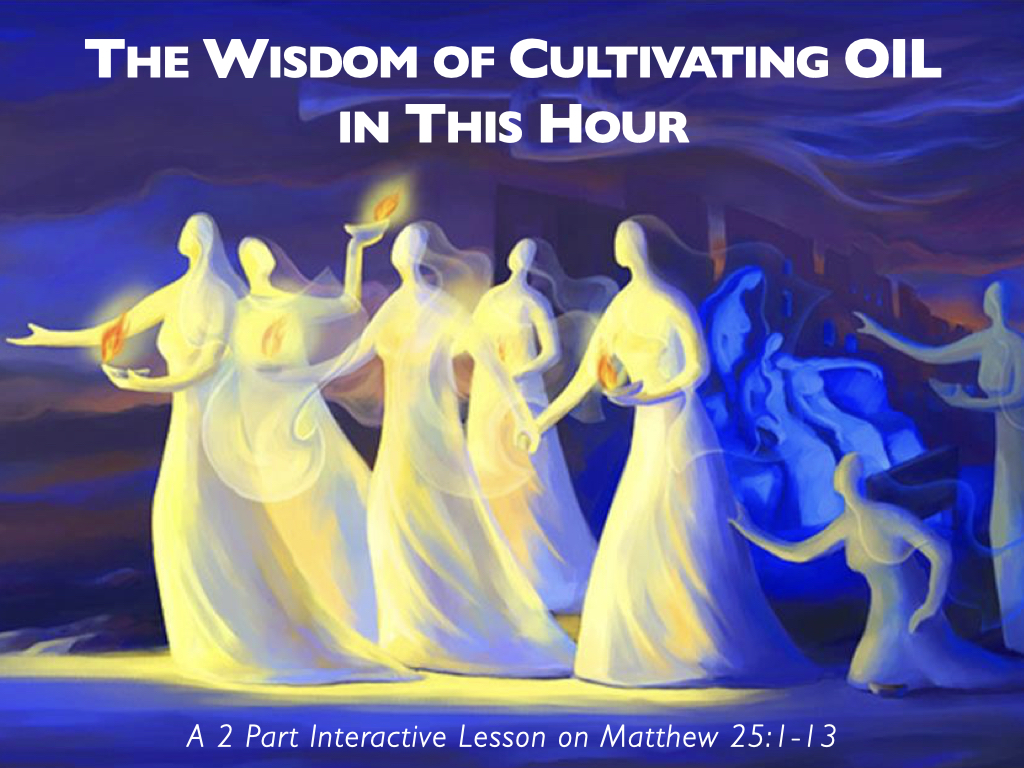
An Interactive Two-Part Lesson on Matthew 25:1-13, Jesus’ Parable of the Wise and Foolish Bridesmaids
PREFACE:
All around the world, life, commerce, industry, worship patterns, families, districts and nations have been brought to a stand-still on account of our human susceptibility to a small germ. In a matter of weeks, the Lord has humbled 7.4 billion individuals in order to enter into conversation with them over the state of their soul.
How are we to understand this unparalleled human event? What is God wanting? What needs to change in our lives in order for us to make room for what He wants? What are we to prioritize? What are we to be concerned about in our lives? How do we respond to a God Who exhibits such universal control over humanity?
These may have been many of the same questions that the disciples were asking themselves as Jesus was telling them about the utter destruction and chaos that was coming to their nation, and the world in Matthew 24. These were to be the features of the end of the age? Their heads had to be swirling with questions.
In Matthew 25 Jesus begins to address these questions in the form of three parables – all three about the return of the Lord, and the transitioning of one age to another under the reign of the Messiah.
Whether we’ve given the return of Jesus much thought, or little thought, belief in His literal return is a foundational teaching to every stripe of Christianity. Every generation, on every continent, within every denomination of the Church declares that Jesus of Nazareth, an executed Jewish, God/Man is returning to earth in resurrected flesh to judge and rule the nations of the earth. This event will be even more profoundly paradigm-shifting than the events of Azusa Street, World War 1, World War II, the formation of Israel and the proliferation of the universal disease of unrighteousness, all combined. The impact of the events that will precede His second-coming will have on our world is inestimable. And yet, Jesus cuts through the sensational, in order to address the personal ramifications of His return. How is humanity to prepare for His return? How is the Church to prepare herself, and help humanity prepare for the new normal, the new values, and the new government that will surround His arrival?
These are some of the momentous questions that confront us as we take up a study of the first parable of the bridesmaids in Matthew 25. That we must address these difficult, hard-to-face questions is demanded by the terrible consequences of not dealing with them, attached to all three of Jesus’ parables in this chapter.
I. THE WISDOM OF UNDERSTANDING MATTHEW 25
A. It is supremely wise for the Body of Christ to give themselves to understanding Matthew 24 and 25. Matthew 25 is the second part of Jesus’ answer to His disciples’ question about the “end of the age” (Matthew 24:3)
B. In Matthew 24 Jesus tells His disciples about the difficulties and deceptions that will accompany the end of the age. In the moments before He returns the Lord will release supernatural signs and calamities that will stir up great social, political and economic crises on the earth. These crises will deeply shake the emotions, beliefs and worldview of billions of people.
What great calamities may come to your world? How might this shake and threaten your life, your emotions, and what you believe about God?
_________________________________________________________________________________
C. At the beginning of Matthew 25, Jesus turns His attention to describing what His followers will need to do to prepare themselves for these unprecedented events. He does this by telling three parables. By using parables Jesus is able to instill a sense of alarm, impart truth, and invite His hearers into the mystery of the storyline. As we hear these parables, we’re invited into these same dynamics.
D. Jesus makes these parables intentionally alarming, because He loves us and doesn’t want us to be caught off-guard and unprepared. A good Father informs His children about life-threatening realities so that they can be appropriately equipped to face them, knowing that the crises can be overcome.
E. It is vital that we invest time to dialogue with the Lord now about Matthew 24 and 25.
1. We want to have clarity on the Biblical narrative of the end times so we can, more or less, understand what issues are at risk.
2. We want to have clarity on what kind of preparation we need to make for this hour in history.
F. A little clarity will produce great stability and confidence in our soul while our world is being buffeted by these extreme events. You don’t want to have to learn a new way of life in the midst of the demands and chaos of crises. Putting a little effort into understanding this hour of history now is like making sure you have enough water, food, medical supplies etc. in your basement for the storm that’s on its way. Beloved, intense storms are on their way. We don’t want to face them unaware of what the Bible has to say about them.
G. As we study this portion of scripture, the question the Holy Spirit is most eager to confront us with is: Through all of the pressures and trials that are here, and are coming, are you developing a lifestyle that’s cultivating oil?
How would you answer this question about your own life, right now?
_________________________________________________________________________________
II. A PARABLE ABOUT THE CHURCH
A. It’s important to know that this parable is a lesson about the Church, for the Church. This isn’t a parable about the non-Christians and the Christians. It’s a parable designed to stir the Church to consider those who have prepared for Jesus’ arrival, and those who have not. When we realize that Jesus isn’t speaking to someone else, or about something else, but that He’s talking to us, and about what we need, it makes His story all the more of a matter of concern.
B. How do we know this parable is about the Church, and not about the lost and the redeemed?
1. All ten bridesmaids are waiting eagerly for the Bridegroom, and exhibit passion to go in and be with Him.
2. All want to be in good-standing with the Bridegroom.
3. All identify the Bridegroom as “Lord” (v.11).
4. All have had oil; that which was necessary to go in with the Bridegroom.
C. What’s the lesson that Jesus is speaking to the Church?
1. In chapter 24 He cautions them that because of the deception, difficulties and destruction of that hour the love of many will grow cold (Matthew 24:12). In Matthew 25, Jesus is alerts His disciples to not let their lamps go out, like the foolish bridesmaids.
2. The distinction that Jesus makes between the wise and foolish bridesmaids is similar to the distinction Paul makes in Ephesians 5 when he advises the church: See then that you walk circumspectly; not as fools, but as wise – redeeming the time, because the days are evil. (Ephesians 5:15)Here, Paul is exhorting believers to pay attention to the vibrancy of their souls. He’s warning them to not give themselves to issues, activities, lifestyles and attitudes that will cause God’s life in them to dissipate (v. 18), diminish and waste away. Paul described the foolish as those who have departed from the faith giving heed to deceiving spirits… (1 Timothy 4:1) and have suffered the shipwreck of faith (1 Timothy 1:19) These are the same threats that Jesus exhorts His disciples to watch out for in Matthew 24.
D. The point of Jesus’ lesson isn’t to argue about how much faith is necessary to be saved. That’s a minimalist religious argument. Jesus wants His disciples to understand the tumult of the hour so that their relationship with Him is not hindered. He loves them and wants them make every provision so that when He returns they are ready to go in with Him (v.10) and are not unexpectedly turned away at the door.
How would you respond to Jesus if He were to pointedly confront you face to face with this parable?
_________________________________________________________________________________
E. The warnings of Jesus and the New Testament writers are clear. Mounting deception and the difficulties in our world will cause the faith and love of Christians to wane, and grow cold. We need to know this, and prepare our souls to withstand these intense circumstances.
III. THE GREAT VALUE OF OIL
A. It’s vital that we cultivate an appreciation for the great value of oil – especially the closer we come to the day of His return. We not only need oil, we need to know that we have oil.
What tells you (personally, today) that you do, or do not possess sufficient oil?
_________________________________________________________________________________
B. We need oil because, according to Jesus, the consequences of not having oil are so dire. Half of the bridesmaids do not have oil and not allowed to enter into the wedding feast. The foolish bridesmaids “alarm” at the midnight hour tell us how urgently we should pursue cultivating oil today. We do not want to hear the Lord say: “I do not know you.” (Matthew 25:12)
C. The Holy Spirit is passionately committed to preparing the Bride for the day of the Bridegroom’s arrival. The Holy Spirit is zealous that we, the Church, would make ourselves ready (Revelation 19:7)and be without spot, wrinkle or blemish when Jesus returns to rule over the earth. (See Ephesians 5:25-27) The Holy Spirit wants the Bride to be in joyful obedience to the Bridegroom when He arrives.
1. The truth is, in as much as the wedding banquet will herald a new Kingdom on the earth, the wedding banquet will also function very much like an inaugural ball. As the event coordinator, the Holy Spirit is zealous for us, the Church, ie. the “guests” to lavishly celebrate the new ruler, and be wholehearted in our zeal for His governmental reign.
2. There are many ways that guests may attend an inaugural ball. Guests may attend reluctantly. They may also participate out of a dull sense of obligation or duty. Guests may come with negative or contrary attitudes about the other guests, the election process, or the new ruler him/herself.
(Our attitude toward the Day of the Lord is actually a deep matter of discussion with the Lord. He has a lot to say about what might be in our hearts, [ie. bitterness, fear, shame, hostility, unforgiveness etc.] on the day He returns. He also has a lot to say about what He’d like to see in our hearts on that day.)
a.) When the bridegroom returns we will want to fully love (and rejoice at)His appearing (2 Timothy 4:8); not harboring “negative” thoughts about His arrival.
b.) We will also want to go in (in whole-hearted alignment and agreement) with Him (Matthew 25:10); not being offended by His character, His values or His behavior (as many were at His first-coming.)
c.) In the days ahead, there will be many things that will pose difficulties for the well being of our heart and soul. These difficulties will come in the form of many judgments upon the earth; judgments where millions will die. Millions will be more than inconvenienced. Billions will struggle for life-sustaining resources; be tempted to look to governmental solutions; be tempted to go to war with others over injustices; be tempted to even curse God and die.
3. If we don’t have oil, we will be greatly tempted to be offended by others who will pose an increasing threat to our life and our family’s lives. We will also be severely tempted to be offended by God and His judgements upon the earth.
4. Oil is the lubricant that guards our hearts against the friction of offense. It enables us to joyfully herald His arrival and be in agreement with how He speaks and acts (about rewards and judgments, policies and management style) when He arrives.
Blessed is anyone who is not offended because of Me. (Luke 7:23)
D. Consequently, anything that keeps us from cultivating an abundance of oil in this hour is a dangerous distraction. We may give ourselves to many other kinds of activities, but if we’re being kept from cultivating oil we’re missing the point of this hour of preparation, and, most importantly, we’re allowing our soul to remain in a dangerous, compromised state.
The foolish virgins were without oil not because they were resisting the Lord’s return. They were quite enthusiastic for the Bridegroom’s return. The foolish bridesmaids were without oil because somewhere, sometime their “self-satisfaction” convinced them that doing something else was as important as their need to buy more oil.
IV. IDENTIFYING THE OIL
A. There are two prominent wrong interpretations of what the oil is.
B. Because these wrong interpretations produce a relaxed, lukewarm, laissez-faire attitude toward the lesson of Jesus’ story it’s important that we understand what these wrong interpretations are. We do not want to console ourselves about our readiness for Jesus’ return when the Holy Spirit is giving us no such consolation.
C. The two misleading interpretations are
1. The oil is the “Holy Spirit”. Though the oil comes from interaction with the Holy Spirit, oil is not itself, a synonym for possessing the “Holy Spirit”.
a. Where does scripture suggest we can accumulate a surplus of the Holy Spirit?
b. How does an individual go and buy more of the Holy Spirit?
c. How does one not immediately receive the Holy Spirit, when one asks for the Holy Spirit?
2. The oil is “faith”. Though it will ultimately manifest as faith, the oil is not a word-picture for faith.
a. A person, like the thief at the cross, may immediately have faith.
b. All ten bridesmaids had enough faith to know Who the Bridegroom was, to wait for his arrival, and wanted to go into the wedding feast with Him.
c. The five foolish bridesmaids exhibit faith when they identify the bridegroom as “Lord”.
D. Our description of the oil must be consistent with how Jesus describes the oil:
1. It’s precious, and greatly desired.
2. It’s costly to obtain.
3. It can be accumulated in abundance.
4. It cannot be transferred from one person to another.
5. Without it we are kept from the presence and the reward of the Lord.
E. The Bible is filled with scriptural parallels to what Jesus is describing as “oil” in Matthew 25:1-13. What the oil represents is one of the most prominent themes in all of scripture.
Below are eight scriptures that give us clues about the precious nature of the oil. Each of these stories and texts are worthy of probing study and dialogue with the Holy Spirit.
1. The Matthew 25 oil is the one thing, the seeking, dwelling, beholding, inquiring, the seeking of the Lord’sFace and the waiting on the Lord of Psalm 27:4, 8, 14
What was David yearning for in Psalm 27?
_________________________________________________________________________________
2. The Matthew 25 oil is the abiding in Me, and I in you, of John 15:4 & 9
What does Jesus mean when He calls His disciples to abide? What type of relationship is Jesus exhorting His disciples to in John 15?
_________________________________________________________________________________
3. The Matthew 25 oil is what Paul prays for the Ephesians church in Ephesians 1:17-18; that the God of our Lord Jesus Christ, the Father of glory, may give to you the spirit of wisdom and revelation in the knowledge of Him, that the eyes of your understanding being enlightened, that you may know what is the hope of His calling, what are the riches of the glory of His inheritance in the saints…
What dynamic(s) is Paul interceding for on behalf of the Ephesian believers?
_________________________________________________________________________________
4. The Matthew 25 oil is what we see Mary obtaining in Luke 10:39, when Mary sat at Jesus’ feet and heard His Word. Indeed, Jesus Himself says, Mary chose the one thing that was needed, the good thing that cannot be taken away from her.
What is it that Mary is hoping to receive from Jesus in this story?
_________________________________________________________________________________
5. The Matthew 25 oil is what we see Moses and Joshua receiving in Exodus 33:11; So the Lord spoke to Moses face to face, as a man speaks to His friend. Moses would return to the camp, but his servant, Joshua, the son of Nun, a young man, did not depart from the tabernacle day or night.
What was Moses experiencing in Exodus 33? What is it that so captivated Joshua, that he would not leave the tabernacle day or night?_________________________________________________________________________________
6. The Matthew 25 oil is what the disciples were saturating themselves with in the upper room in Acts 1 & 2 as they continued with one accord in prayer and supplication prior to being baptized in the Holy Spirit.
What were the disciples experiencing in the upper room in Acts 1 and 2? What was the atmosphere like? What kind of exchange was going on?
_________________________________________________________________________________
7. The Matthew 25 oil is synonymous with the gold refined in the fire in Revelation 3:18 that Jesus counsels the Laodicean Church to buy from Him, that they may be rich.
What was Jesus exhorting the Laodicean church to secure from Him? How were they to obtain it?
_________________________________________________________________________________
8. The Matthew 25 oil is what Paul was ready to give everything up for in Philippians 3:10; that I may know Him and the power of His resurrection and the fellowship of His suffering, being conformed to His death.
What was it that Paul was yearning for?
_________________________________________________________________________________
Few studies will prove more fruitful in this hour than to dialogue with the Holy Spirit over these eight texts. He is vitally enthusiastic to disclose these mysteries to those who will seek His Face regarding the nature of oil.
Take time to review each of these 8 texts. Ask the Holy Spirit to show what each of these texts have in common. Then write out your own one-sentence definition of what the oil is.
_________________________________________________________________________________
V. DIALOGUING WITH THE HOLY SPIRIT ABOUT CULTIVATING OIL
A. At the end of the day, it’s vital that we seek God’s face for ourselves about the identity of the oil. Although a teaching can point the way, there’s no substitute for having the Holy Spirit impart His life- giving truths to your heart Himself.
B. As we increasingly see the value of oil, and our great need for oil we can rejoice knowing that we are in a blessed place. It’s the Lord’s supreme kindness to tell us “our oil is low”. (In this COVID-19 season, He’s even provided us with protected time and space to cultivate this oil!) If you’re feeling an increased desire for the abundance of oil in your life, rejoice! The Holy Spirit has planted that seed of awareness in your heart, and it’s taking root.
Blessed are the poor, (those who know that they lack) for their’s is the Kingdom of heaven. (Matthew 5:3)
C. In response to this growing hunger, it’s right for us to repent of having fallen asleep (Matthew 25:5) and not having pursued what the Holy Spirit has ardently wanted you, and the rest of the Bride of Christ to be filled with.
Our repentance is an act of humility that acknowledges His gracious and patient work on our hearts. It’s an act of contrition that says we’re sorry for having given ourselves to things which do not abundantly profit.
• It’s a pledge to no longer give our lives to dissipation.
• It’s a declaration of our will to obey Him, and embrace a new value.
• It’s a beacon to heaven signaling that our hearts are now ready to go and buy and receive.
Write out your own prayer of humility and repentance to the Holy Spirit here:
_________________________________________________________________________________
_________________________________________________________________________________
_________________________________________________________________________________
_________________________________________________________________________________
D. The foolish virgins were without oil not because they were resisting the Lord’s return. They were quite enthusiastic for the Bridegroom’s return. The foolish bridesmaids were without oil because somewhere, sometime their “self-satisfaction” convinced them that doing something else was as important as their need to buy more oil. The question for each one of us is: What did the enemy use to lure the foolish into a mind-set that distracted them from obtaining oil? How might you answer this question in your own life?
What issues, temptations, threats and world-situations might distract you from building a life that is prioritized to cultivating oil?
_________________________________________________________________________________
E. We can begin to engage the Holy Spirit through a straight-forward prayer like this:
We seek Your Face, Father. Holy Spirit, teach us about the oil. Show us the great value of the oil, and show us how to obtain it. We want to heed Jesus’ warning and be ready for His return. Forgive us for not pursuing either the oil, nor an understanding of the oil. Forgive us for spurning Your invitations. Give us grace to embrace a new value, and new priorities. Show us how to establish them in our lives, so that we live in a way that will produce an abundance of oil. Thank You for Your mercy, Your patience and Your willingness to give oil to us today. In Jesus’ Name.
End of (Part I)
The Way to Cultivate OIL in This Hour
Part 2 of 2
PREFACE
The value that Jesus attaches to the oil in this parable bids us to ask the question: How do I secure the oil I’m going to need to have in the moment of His arrival? This question should be addressed no less seriously than the question of whether we’re able to feed our family, provide for their safety and draw our next breath. The following section is designed to help the sober soul calculate their need and devise a plan to cultivate oil. As the old adage goes: to fail to plan is the plan to fail.
I. 4 QUESTIONS TO FOCUS OUR PURSUIT OF OIL
As we consider our own need for oil, there are several very beneficial questions we can keep in front of ourselves to help us set goals, confront obstacles and inspire us to accumulate oil. The parable tells us accumulation oil will require clear vision, cost-counting planning, a steady lifestyle that triumphs over inevitable slumber, and soul-satisfying inspiration and reward.
A. We need a clear vision.
One question we can ask to help us identify the clear vision of what we are pursuing is: What do I want my heart to be filled with on the day I meet our Bridegroom King?
1. The Holy Spirit is eager to meet us in this question and help us fill our hearts with the attitudes and qualities that are most pleasing to our King. This is a great part of what Revelation means when it observes: “Let us be glad and rejoice and give Him glory, for the marriage of the Lamb has come, and His wife has made herself ready.” (Revelation 19:7)
2. Some of the attitudes and qualities that I want my heart to be filled with in include: Awe, excitement, humility, gratitude, zeal for others’ well-being in God, compassion, tenderness, worship, yieldedness to His ways, agreement with His leadership, first-commandment love, trust, intimacy, no shame, purity, integrity, forgiveness, mercy-giving, desire for unity with Him and others, adoration etc.
3. On that day when we meet, one of the heart dynamics that will be most valuable to us will be to look into His smiling eyes and rejoice over the shared history of love that we had cultivated with each other. Episodes like this corona-virus season, are a marvelous, focused opportunity to increase in our focused love and understanding of this Man; a Man that we will soon see face to face.
4. Another way to ask this second question is to ponder the question: What is this Man worthy of? On the day that we first meet Him, as His eyes flash with zeal for righteousness and determination, our hearts will suddenly have new, first-person revelation about how much this Man is worthy of. Scripture keenly defines these qualities about Him so that we do not have to be surprised about Who He is then, but can be filled with understanding about Him now. The Holy Spirit is eager to give our seeking hearts revelation about the beauty and majesty of Jesus, so that we are prepared to give Him what we’ll want to give Him in that hour. In the moments that we first see Him, we will not want to be filled with regret about the little that we’re offering Him.
What do you want your heart to be filled with when you first meet the Bridegroom?
_________________________________________________________________________________
B. We also need to know what it will cost us to secure oil.
If we’re intent on cultivating enough oil sufficient for the day, we will need to ask the question: What will it cost me to purchase an abundance of oil?
1. Jesus tells us, the oil must be “bought” (v.9). The purchasing of the oil entails an investment of our wealth in that which is profitable (Isaiah 55:2) to have in our heart for that day… Again, engaging in this “divine exchange” is costly. (Revelation 3:18) Understanding the costly nature of oil leads us to reconsider adjusting the way we budget our lifestyle/time/ resources so that we do indeed accumulate “more”, and don’t merely console ourselves by thinking that because we wanted more, we, in fact, actually received more. We don’t want the mirage of oil. We want the manifestation of oil in our vessels.
2. The question of cost also confronts us to examine the way we’ve been spending (or not spending) the “wealth” of our Christian lives: our time, energy, priorities and resources.
For which of you, intending to build a tower, does not sit down first and count the cost, whether he has enough to finish it – lest, after he has laid the foundation, and is not able to finish, all who see it begin to mock him, saying, ‘This man began to build and was not able to finish.” (Luke 14:27-29)
Where have we allowed Christian activity and superficialities to marginalize His invitation to focused, intimate fellowship? Where have we neglected to make this investment in knowing Him? These questions are critical doorways unto the crushing, deepening, humbling work of repentance, apart from which no one may receive oil. At the end of the day, There is none who understands; there is none who seeks after God. They have all turned aside; they have together become unprofitable. (Romans 3:11-12)
We’re all dependent upon the gracious, patient pursuit of the Holy Spirit. No one receives oil without a repentant attitude. The need for a broken spirit and a contrite heart in accumulating oil cannot be overstated.
What will it cost you to purchase an abundance of oil?
_________________________________________________________________________________
C. In the best of times, we can easily be diverted from cultivating oil. Therefore, it is wise to consider now: Are we developing the kind of lifestyle that will be capable to cultivate oil through all the testing, shaking, and judgments that are coming? We want to know: Do we have the depth and strength of intimate relationship with the King that will not be swayed with the increasing tribulation in our world? We want to know that we possess the kind of love that Solomon described in his Song of Songs:
Many waters cannot quench love, nor can the floods drown it. If a man would give for love all the wealth of his house, it would be utterly despised. (Song of Songs 8:7)
Am I developing the depth of love for the Bridegroom that can withstand the anxieties, accusations, deceptions and temptations that will increasingly fill our world?
What does a lifestyle that’s cultivating sufficient oil for an hour of tribulation look like?
_________________________________________________________________________________
D. When the way is foggy. When our hearts inevitably grow weary, we need a question to plumb-line our resolve. At the nexus of the whole endeavor is the question: Who is this Man? Who is this One Who is telling us about the end of the age, and warning us of the dire consequences of not preparing for its arrival? No other question begs to be explored more than the question about this Man’s identity and character. No other question will provide more intrigue, fascination, passion, motivation or reward than allowing the Holy Spirit to draw you into the revelation of the uncreated, crucified and resurrected, Jewish, God/Man. This was the magnificent obsession of Mary in (Luke 10:39) and John the beloved in (1 John 1:1-3; Revelation 1:17).
The adventure of pursuing this question is all more compelling when we realize that it is Jesus Himself Who is drawing us to come close to behold His Person.
Father, I desire that they also whom You gave Me may be with Me where I am, that they may behold My glory which You have given Me. (John 17:24)
The revelation, and the experience of pursuing the revelation of Who He is, is pure oil.
This is also the question we will want to return to when the whole world is shaking, and we can’t see or think straight.
How would you describe Jesus of Nazareth? Who do you say that He is?
_________________________________________________________________________________
II. WATCH & PRAY: THE KEY TO CULTIVATING OIL
A. Watching and praying is Key to Obtaining an Abundance of Oil
Watch therefore, and pray always that you may be counted worthy to escape all these things that will come to pass and to stand before the Son of Man. (Luke 21:36)
1. An abundance of watchful prayer produces an abundance of oil. Little prayer produces little oil. No prayer produces no oil. If we’re serious about cultivating oil, it’s absolutely essential that we take inventory on how much attention we’re giving to the focused activity of prayer.
2. Just as the five foolish virgins were deluded about their preparation for the Bridegroom’s return, many Christians live in tragic deception about the quality of their relationship with the Lord. The revivalist, Leonard Ravenhill declared: “No believer is greater than her/his prayer life.” No matter what else we may think we are, or have accomplished for the Kingdom, we are no greater than our intimate life of humility and dialogue before the Lord.
3. Jesus gives us a startling sneak-preview of His judgment upon the lives of mankind at the end of His sermon on the Mount. He warned that many would be sadly mistaken about the nature of the familiarity of relationship with the Lord when He asserts:
Not everyone who says to Me, ‘Lord, Lord,” shall enter the Kingdom of heaven, but he who does the will of My Father in heaven. May will say to Me in that day, ‘Lord, Lord, have we not prophesied in Your name, cast out demons in Your name, and done many wonders in Your name?’ And then I will declare to them, I never knew you; depart from Me, you who practice lawlessness.” (Matthew 7:21-23)
The parallel between Jesus’ words here I never knew you, and the parable of the ten bridesmaids (Matthew 25:12) I do not know you, should strike a two-fold witness to our heart.
4. At the end of his life, Billy Graham was asked if he had the chance to live his life over, what would he do differently? Dr. Graham’s response was quick: “I’d spend more time in prayer. I’d spend more time reading His Word and telling the Lord that I love Him.”
The dynamic, intimate relationship that is cultivated in honest, humble prayer is the essence of oil.
B. How then do we PRAY?
If we want oil, we need to know how to pray. If we want to know that we have oil, we’ll need to know that we have P.R.A.Y.E.D. The following acronym can help us identify a thorough way to engage the Lord in prayer – and He with us. These six qualities are not so much of a linear recipe to follow as they are a steady diet to fill ourselves with. Oil will be the reward of our engaging in these dynamics, just as physical health is the reward of a proper diet.
1. PROTECT and PREPARE
The fact of nature is, we cannot buy oil on the run. While it is possible to accumulate oil anywhere, it is impossible to secure it and not be given to much prayer.
a.) Moses and Joshua cultivated oil constrained to times and a “tent of meeting” in the wilderness. (Exodus 33:7-11)
b.) Just before He ascended, Jesus bound His disciples to the experience of prayer. (Acts 1: 4) He told them not to leave Jerusalem. They obeyed Him, and gave themselves to prayer and worship in an upper room. (Acts 1:14) When they were baptized in the Holy Spirit their lifestyle was all-the-more bound the a rhythm that prioritized prayer. (Acts 2:42, 46 and 3:1)
c.) If we do not, protect our time and place of prayer, the business of the day, the distractions of the world and the enticements of the urgent will flood our holy space.
d.) As a leader who has been ardently pursuing prayer for more than three decades, it is imperative that we set hours and space for our prayer time – or we will not pray. Neither will we establish the priority of prayer in our lifestyles. The wise Bridesmaids didn’t accumulate oil based on merely having a rhetoric of prayer. They had the reality of a real prayer-life.
2. RECEIVE REVELATION of the LORD and READING the Word of God.
a.) As we respond to the Holy Spirit in prayer, He immediately confronts us with revelations of the Lord’s beauty, His graciousness, His majesty, His Holiness. These revelations may flow from worship, or a hunger to read the Word, or they may come from the Holy Spirit directly, Who loves to take the qualities of Jesus and declare them to our “stilled” hearts.
We are experiencing what Jesus told us about the Spirit in (John 16:13-15):
The Spirit of truth… will glorify Me, for He will take of what is Mine and declare it to you. All things that the Father has are Mine. Therefore I said that He will take of Mine and declare it to you.
b.) As we behold Jesus, we also behold the way He relates to the Father, to others and the way runs His Kingdom, and in beholding Him we learn our own pattern for humility, love, holiness, kindness and zeal.
c.) We are not only informed by these Words of the Spirit, we are shaped and conformed by them.
We all, with unveiled face, beholding as in a mirror the glory of the Lord, are being transformed into the same image from glory to glory… (2 Corinthians. 3:18)
3. ASCRIBE, ACKNOWLEDGE and ADORE the character of the Lord.
a.) As we engage the Holy Spirit’s declarations about Jesus, our minds and our hearts are brought into alignment with the truth of Who God is. This is the dynamic work of the Holy Spirit. He is our guide in this indescribably glorious atmosphere. We are entirely dependent upon the His counsel on how to speak and behave. He will lead us into all truth. (John 16:14) As we see what He shows us, we yearn to respond according to the order of the realm in which we’re dwelling. In His gracious way, the Holy Spirit gives us Words, lyrics, jubilations, thoughts, visions, sensations that we may exalt, praise and magnify the Father, and the Son.
Ascribe unto the Lord, O you mighty ones, Ascribe unto the Lord glory and strength. Ascribe unto the Lord the glory due to His name; worship the Lord in the beauty of holiness. (Psalm 29:1,2)
b.) We tread fearfully, with an ever increasing desire to more fully and worthily enter into the beauty of holiness that is all around us. It is here that we see how intensely God’s desire is to
be intimately close with us.
Who may ascend into the hill of the Lord? Or who may stand in His holy place? He who has clean hands and a pure heart… He shall receive blessing from the Lord, and righteousness from the God of his salvation. This is Jacob, the generation of those who seek Him, Who seek Your face. Selah Lift up your heads, O you gates! And be lifted up, you everlasting doors! And the King of glory shall come in. Who is this King of glory? The Lord strong and mighty, The Lord mighty in battle. Lift up your heads, O you gates! Lift up, you everlasting doors! And the King of glory shall come in. Who is this King of glory? The Lord of hosts, He is the King of glory. (Psalm 24:3-11)
4. YIELD
a.) In the atmosphere of holiness, we would be consumed by His mere breath if we were not to align our hearts, mind, will, words, attitudes, behaviors etc.; all that we are, with the truth of Who we are encountering. This is the process of repentance, humility and yieldedness. b.) In the worship of repentance we divest ourselves of that which pollutes this holy atmosphere. We surrender sin, selfishness, fleshly wisdom and all forms of unrighteousness, all with the expectation of entering more fully into the goodness of His increasing reign.
c.) Yieldedness and repentance is the response of all creation to the approaching presence of the uncreated God. This is what Isaiah was describing in (Isaiah 40:3-5)
Prepare the way of the Lord; Make straight in the desert a highway for our God. Every valley shall be exalted and every mountain and hill brought low; The crooked places shall be made straight and the rough places smooth; The glory of the Lord shall be revealed, and all flesh shall see it together; For the mouth of the Lord has spoken.
d.) In the revelation of the Lord’s ascending glory, it is only right that we have a “yes” and “amen” in our spirits. This is our proper response to the way of Jesus. We operate in fidelity and agreement with Who He is, What He’s promised and What we’ve asked of Him.
For all the promises of God in Him are Yes, and in Him Amen, to the glory of God through us. (2 Corinthians 1:20)
e.) But in heaven this yieldedness is a two-fold yes.Our yes to Him, also means that we tap into His miracle of agreement with other believers who are praying and cultivating oil. Though the oil may not be transferred, one to another here on earth – each has their own secret life with God – we have the capacity to encourage, inspire and amplify other members of the body of Christ as we cultivate oil together. This is the exponential power of corporate prayer and worship.
Behold, how good and how pleasant it is for brethren to dwell together in unity! It is like the precious oil upon the head… (Psalm 133:1-2)
5. ENTREAT the LORD
a.) It’s in this context that we come before the throne. It is a great throne, but it’s a throne of grace.
Let us therefore come boldly to the throne of grace, that we may obtain mercy and find grace… (Hebrews 4:16)
b.) The King Himself invites us and has even (wonder of wonders) made provision for us to sit with Him, in the seat of authority.
(He) raised us up together, and made us sit together in the heavenly places in Christ Jesus (Ephesians 2:6)
c.) Here we may ask and participate in the eternal order of the Kingdom: intercession. It’s as we watch Jesus ask the Father for His Hand on issues, circumstances, nations, creation, and individual hearts that we learn the Family way of the Kingdom – and we too, ask, entreat, petition and make requests of the Father.
“And whatever you ask in My Name, that I will do, that the Father may be glorified in the Son.”(John 14:13)
6. DIALOGUE
a.) In prayer with Him; surrounded with His glory, we are given (prompted by the Spirit’s initiative) to make inquiry – and to engage the Trinity in conversation. This is the what we were created for; first Adam, and now us: communion with the Word-speaking God.
b.) This dialogue with God is what Moses was invited into.
And it came to pass, when Moses entered the tabernacle, that the pillar of cloud descended and stood at the door of the tabernacle, and the Lord talked with Moses…So the Lord spoke to Moses face to face, as a man speaks to his friend. (Exodus 33:9,11)
c.) This intimacy is what David was describing in Psalm 27:4 and 8
One thing I have desired of the Lord, that will I seek: That I may dwell in the house of the Lord all the days of my life, to behold the beauty of the Lord, and to inquire in His temple..
…When You said, “Seek My face,”My heart said to You, “Your face, Lord, I will seek.”
d.) This is also the dynamic word-shaping power that we share with other believers, even while still on earth: Speaking the truth in love, one to another; in this way we grow up in all aspects into Him, Who is our Head. (Ephesians 4:15)
III. BURNING WITH THE PROPHETIC CRY
A. In this hour, the Spirit is crying out to the Church and the world.
“Wisdom shouts in the street. She raises her voice in the markets.” (Proverbs 1:20)
B. It is a cry that the Spirit is zealous to proclaim with the Bride; one that illuminates the Bridegroom, that heralds His coming and calls all into allegiance to the approaching the Bridegroom King.
C. The cry is meant to be a corporate cry of agreement that looks and feels like the unanimity in heaven and is in league with the power of the Spirit.
Behold the Bridegroom! He’s coming! Go out to meet Him! (Matthew 25:7)
D. This is the cry the world urgently needs to hear – with clarity! And it’s the cry that will usher in earth’s last revival; the salvation of billions of souls. It will also herald the greatest transition in the history of the world.
E. This cry may only be fueled by the oil we receive. In order for this cry to be clear and compelling, we must know Him (Matthew 25:12) intimately. We must cultivate the oil of intimate encounter with Him. The oil we receive burns unto one end: the illumination of the Bridegroom, Himself! As our lamps burn, they illuminate His beauty wherever we go.
1. The call to cultivate oil is the Holy Spirit’s “new normal” for the Church. All around the world, at the same time, the Holy Spirit is leading the whole Church into a brand-new Bridegroom-engaging, Bridegroom-dependent, Bridegroom-increasing normal.
2. There is no going back. It’s vital that we go forward, accumulate oil, take our lamps to illumi- nate the Bridegroom, and go out to meet Him. The Holy Spirit will have it no other way.
3. a.) The “new normal” isn’t about remote teaching, or house to house restructuring, or developing critical care networks. It’s all about securing oil.
b.) The one question that dominates the dialogue of heaven as our world throws off this season of “lock-down” is: “Did the Church learn how vital it is that she have oil?”
c.) The church that doesn’t humble herself, shift her paradigm, prioritize, and practically give herself to cultivating oil will not remain in the hours that are approaching… It may know enthusiasm, new technology and renewed energy, but she will not know the abiding, dwelling, presence of the Lord. Her many words and activity will be kicking against the goads… not making the “rough places smooth” (Isaiah 40:4) for the revelation of the glory of the Lord.
4. Beloved, anything that keeps us from cultivating oil in this hour is a distraction – a dangerous, slumbering, self-content, destructive, distraction.
Write out your own pledge to the Lord. What specific details are you hearing Him call you to put in place in your daily life?
_________________________________________________________________________________
_________________________________________________________________________________
_________________________________________________________________________________
_________________________________________________________________________________
____________________
JSB • Spring, 2020
A PDF Version of this teaching can be downloaded here:
https://drive.google.com/file/d/1rWSv50DcNWJ0aC_UZqMWWA9ssDcY2GFf/view?usp=sharing
 SPIRIT WORD & CROSS