Jeremiah began his prophetic ministry in 627 BC. He gained national notoriety when he first prophesied the destruction of the Temple during the wicked King Jehoiakim’s reign in 609 BC. He warned that if the Judeans would not repent before the Lord, and put away their sinful practices, the destruction of the Temple and exile would follow. Unwilling to listen, the wicked king, the nobility, and the priesthood persecuted Jeremiah and attempted to have him silenced – permanently.
After the traumatic exile of Jehoiachin (Jehoiakim’s son) and 10,000 other leading Judeans twelve years later, there was widespread concern in the land. Suddenly, Jeremiah’s bleak prophecies appeared to be materializing. Nebuchadnezzar of Babylonia was rapidly conquering the world, and the tiny nation of Judah was extremely vulnerable. However, a group of false prophets arose in Judah who predicted a miraculous downfall of Babylon followed by the return of Jehoiachin and the other exiles.
Around the same time, Egypt was fanning the flames of revolt against Babylon. This led King Zedekiah to host an international summit in 593 BC to discuss the formation of an anti-Babylonian coalition. This summit gave the people of Judah all the more religious and political encouragement to oppose Jeremiah’s message of humility and surrender to the ways of the Lord. Why repent and be broken before the Lord, when the hour called for strength, and unity under the banner of national pride and integrity?
Jeremiah appeared at Zedekiah’s summit wearing a yoke; a picture of the Lord’s call for Judah (and the rest of the nations) to dutifully submit and entrust themselves to YHWH’s dependable leadership.
In essence, the line was drawn in the sand. Will Judah attempt to make herself great in the ways of the world? Or would she clothe herself with the Lord’s definition of greatness, namely, “to walk in humble fidelity to God”?
Thus said the Lord to me: Make for yourself thongs and bars of a yoke, and put them on your neck. And send them to the king of Edom, the king of Moab, the king of the Ammonites, the king of Tyre, and the king of Sidon, by envoys who have come to King Zedekiah of Judah in Jerusalem…The nation or kingdom that does not serve him – King Nebuchadnezzar of Babylon – and does not put its neck under the yoke of the king of Babylon, that nation I will visit – declares the Lord – with sword, famine, and pestilence, until I have destroyed it by his hands. As for you, give no heed to your prophets, augurs, dreamers, diviners, and sorcerers, who say to you, “Do not serve the king of Babylon.” For they prophesy falsely to you – with the result that you shall be banished from your land; I will drive you out and you shall perish. But the nation that puts its neck under the yoke of the king of Babylon, and serves him, will be left by Me on its own soil—declares the Lord – to till it and dwell on it. (Jeremiah 27:2-11).
After Jeremiah’s dramatic presentation, the false prophet Hananiah son of Azzur publicly confronted Jeremiah, breaking his yoke and announcing that Babylon would fall in two years (Jeremiah chapter 28). Of course, we are privy to the course of history. Jeremiah was indeed the true prophet, and Hananiah, and the other court-prophets were false.
However, in the real time of the story, one must ask: How were the people – even the most God-fearing ones – to distinguish between true and false prophets? This question was not merely a matter of academic interest. Jeremiah’s forecast of seventy years of Babylonian rule (Jeremiah 25:10-11; 29:10) came with political ramifications: remain faithful to the ways of the Lord, even under the thumb of Babylon, or suffer the destruction of their nation. By predicting the miraculous demise of the pagan empire of Babylon, the false prophets supported strident, prideful, national revolt against Babylon. These were the social media contentions of their day. What was being argued influenced not only matters of state, but also the very survival of the people, their families, and their way of life.
Some false prophets were easier to detect than others. Their flagrant disregard for the Torah discredited them as true prophets. However, Hananiah son of Azzur and Shemaiah the Nehelamite (Jeremiah 29:24-32) both sounded righteous. Neither preached idolatry nor laxity in Torah observance, and both spoke in the name of God. After each prophet made his case, Jeremiah “went on his way” (Jeremiah 28:11). There was no way for the people to know who was right, and therefore they would have to wait to see whose prediction would be fulfilled.
Waiting, however, was not a helpful option. The false prophets were riding the crest of national zeal for revolt now, and what Jeremiah was calling for looked so passive – submissive even.
Before the Lord, Jeremiah bemoaned the mockery he endured on account of the peoples’ refusal to receive his words: “See, they say to me: ‘Where is the prediction of the Lord? Let it come to pass!’” (Jeremiah 17:15). Although Jeremiah would ultimately be vindicated, in the fire of revived national resolve and fervor, his way seemed meek and impractical.
To address these difficulties, Jeremiah presented alternative criteria by which to ascertain false prophets. He staked his argument in the Torah’s assertion that a prophet who preaches idolatry is a false prophet regardless of successful predictions or signs:
As for that prophet or dream-diviner, he shall be put to death; for HE URGED DISLOYALTY TO THE LORD YOUR GOD (ki dibber sarah al A-donai Elohekhem) – who freed you from the land of Egypt and who redeemed you from the house of bondage – to make you stray from the path that the Lord your God commanded you to follow. Thus you will sweep out evil from your midst. (Deuteronomy 13:6)
Strikingly, Jeremiah extended the Torah’s example of idolatry to include anyone who did not actively promote repentance before God. Since the false prophets predicted the unconditional downfall of Babylon irrespective of any repentance on the people’s part, they must be fraudulent:
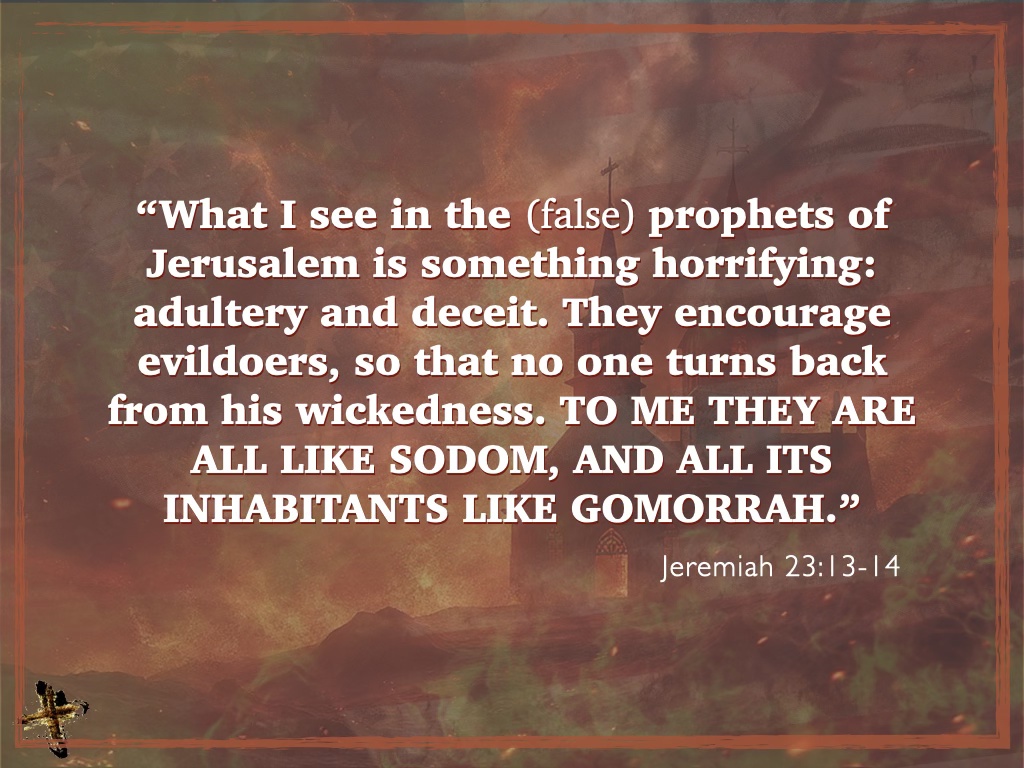
In the prophets of Samaria I saw a repulsive thing: They prophesied by Baal and led My people Israel astray. But what I see in the prophets of Jerusalem is something horrifying: adultery and false dealing. They encourage evildoers, so that no one turns back from his wickedness. TO ME THEY ARE ALL LIKE SODOM, AND ALL ITS INHABITANTS LIKE GOMORRAH. (Jeremiah 23:13-14).
More subtly, Deuteronomy uses the expression, “for he urged disloyalty to the Lord your God” (ki dibber sarah al A-donai Elohekhem). This phraseology is used to refer to specific prophets only twice in the books of the prophets: when Jeremiah censured Hananiah and Shemaiah, the two false prophets who appeared the most righteous:
Assuredly, thus said the Lord: I am going to banish you from off the earth… for you have urged disloyalty to the Lord (ki sarah dibbarta el A-donai) (Jeremiah 28:16)
Assuredly, thus said the Lord: I am going to punish Shemaiah the Nehelamite and his offspring. There shall be no man of his line dwelling among this people or seeing the good things I am going to do for My people, declares the Lord – for he has urged disloyalty toward the Lord (ki sarah dibber al A-donai) (Jeremiah 29:32).
Thus Jeremiah distinguished the true prophet(s) from the false prophets, (even the most undetectable false prophets) according to whose words called for humility, and pure and simple obedience to the ways of the Lord, vs. those who urged disloyalty to the ways of the Lord.
Beloved. This is where we find ourselves today. The parallel between the day of Jeremiah, and the 21 century American Church is striking. (We should let it strike us!)
There is undoubtably a world-wide plague of pagan godlessness that threatens to overtake our world – and our nation. But in the moment of crisis, the Lord is calling His people to resist the temptation to clothe ourselves in our own power and greatness; the worldly dynamics of increased wealth, increased political influence; hostile authoritarianism; and strident uniformity. Instead, He’s calling His people to remain faithful to His ways – the foundational ways that His Son laid out for us in the Sermon on the Mount: “Remain broken. Remain tender-in-heart. Remain meek. Remain hungry for God’s right order. Remain holy. Remain merciful. Remain peaceable. And repent of every way that you have let go of these realities of My Kingdom.”
One of the great, great lies of the last eight years has been the subtle invitation into a false way; a false hope; an invitation to become disloyal to, and distrust the power of the foundational ways of the Lord. The devil’s voice goes sounds like this: “You’re not electing a pastor. You’re electing a President.” In essence, the tempter is saying: “You don’t need the meek way of Jeremiah. You need the power of the hostile, lustful, strident, unrelenting, prideful, forceful, singular-minded way of the world. The way of Jesus’ beatitudes won’t work here.”
I’ve been praying for revival in my nation for all of my adult life. The picture of that revival is one that includes capital buildings as well as churches. It’s a vision of God’s matchless, eternal power and holy glory resting on Presidents, politicians, pundits and pastors. Perhaps we’d all be closer to that reality if we had more voices of the Lord proclaiming that we’ve become the culture of Sodom, and less vaunted victory cries of “America is back”. Perhaps what we need are more present day prophets speaking to our President like Jeremiah, and less time blessing the carnality of his power, like Hananiah. Perhaps it’s time to hear and heed the wilderness, yoked voices that are calling the people of God to repent, and remain faithful to the foundational ways of God.
____________________
JSB • December, 2024
#ChurchOfSodom
NOTE: In this BLOG, I am beholden to the Lord having called our house to pray/read through the book of Jeremiah three times over the last several years; AND an excellent exposition on the life of Jeremiah, by Rabbi Mark D. Angel.
 SPIRIT WORD & CROSS